How much to charge for UGC: beginner rates breakdown
Not sure how much to charge for UGC as a beginner? Get real 2026 rate ranges, the 5 factors that change your price, and a formula to set your first rate.

The first time a brand replied to one of my creators' cold pitches, she immediately cut her rate from $150 to $75. "I don't want to lose them," she told me. The brand said yes without pushing back once.
She left $75 on the table. And she set an anchor for every deal with that brand going forward.
Figuring out how much to charge for UGC as a beginner is one of the hardest parts of getting started — not because the math is complicated, but because the instinct to just get any paid work is overwhelming. That instinct will cost you, repeatedly, until you recognize it and shut it down.
I've watched thousands of creator deals flow through Crelio. The patterns are relentless. Beginners underprice. The brands that say yes instantly are the ones you should've charged more. Here's what actually works.
Why charging $30 per video is a trap
I understand the logic. You're new. Your portfolio has two videos you shot for free. You want a brand name to put on your pitch deck and you'd almost do the first one for nothing just to get it.
But when you accept $30–$50 per video, you're not just leaving money on one deal. You're teaching yourself what your time is worth. And you're teaching the brand what UGC costs — every future request from them anchors to that number.
Then there's client quality. Brands paying $30 for a video come with certain behaviors: vague briefs, three rounds of nitpicking, "can you just redo the hook real quick" requests that eat your whole afternoon. At $150–$200, you attract brands that have actual budgets, structured processes, and respect for deliverables. The work itself is easier.
There's a third problem nobody talks about. When UGC platforms display aggregate creator rates, every $30 deal pulls the average down. Cheap pricing doesn't just hurt you — it slowly deflates rates for everyone in the space.
What brands actually pay UGC creators in 2026
Real numbers. Not aspirational, not the TikTok humblebrag post — actual market rates backed by what I see on the platform and what Influencer Marketing Hub's UGC research documents.
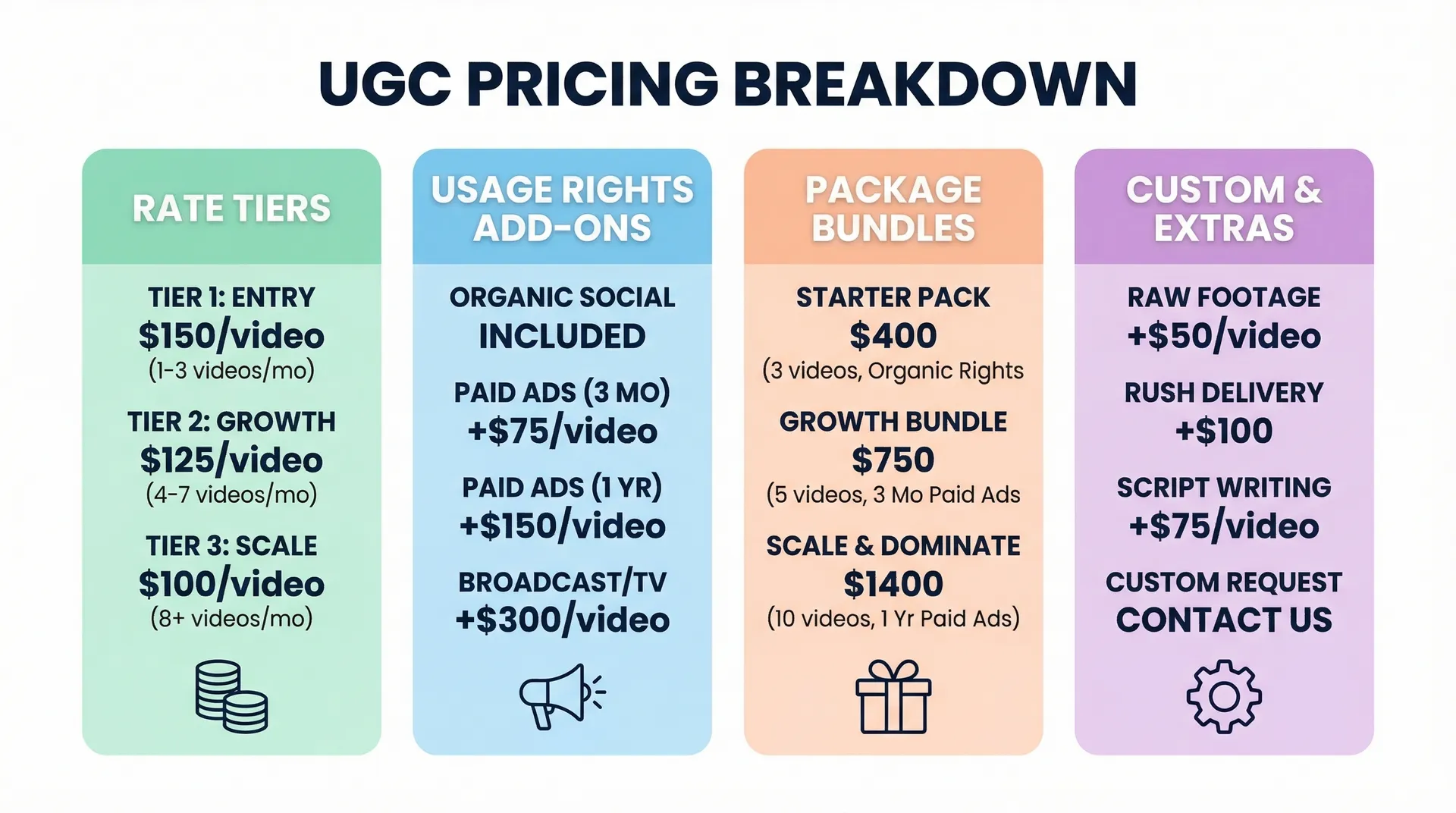
Video (30–60 seconds, vertical format, raw deliverable)
- Brand new creator, 0–5 samples: $75–$150
- Beginner with a few completed deals: $100–$250
- Intermediate, 6–18 months in: $200–$500
- Experienced with a strong portfolio: $400–$800+
Photo packages (lifestyle/product)
- New creator: $25–$50 per image
- Beginner with samples: $40–$75 per image
- Most creators package 5–10 images together
Common beginner bundles
- 3 videos: $300–$450
- 5 videos: $450–$700
- 1 video + 3 photos: $175–$300
These are base rates — no usage rights included. Usage rights are a separate line item, and skipping them is where most beginners leave the most money.
Always ask how the brand plans to use your content before you name a price. "Will this run as a paid ad?" changes what you should charge. Most beginners forget to ask. Don't be most beginners.
Sprout Social's research on UGC engagement consistently shows that authentic creator content outperforms branded content in paid ad performance — which is exactly why brands are willing to pay real money for it. You're not pitching them a favor. You're selling them a high-performing ad asset.
For the full picture of what UGC creators can earn as they build experience, our UGC creator salary & rates guide covers the longer arc from beginner to full-time income.
The 5 factors that actually change your rate
The numbers above are baselines. Where your real rate lands depends on these five variables.
1. Video length A 15-second hook clip isn't the same job as a 60-second demo walkthrough. Add roughly 20–30% for each additional 30 seconds of finished content.
2. Revision rounds One round of revisions should be baked into your base rate. A second round is a $25–$50 add-on. Unlimited revisions is not a feature — it's a boundary problem. Never offer it.
3. Usage rights This is the one that consistently catches beginners off guard. Usage rights allow a brand to run your content as a paid ad. They're not included in your base rate unless you say so.
Standard add-ons:
- 30-day ad usage: +25–35% of base rate
- 90-day ad usage: +50% of base rate
- 12-month usage: +75–100% of base rate
- Perpetual/unlimited: +150%+ of base rate
A $150 video becomes $225 with 90-day usage rights. That's not rounding error.
If a brand is running your video as a paid ad, it might generate $10,000+ in revenue for them. Your $150 base rate suddenly looks very cheap. Charge for the value it delivers, not just the hours it took.
4. Exclusivity A brand asking you not to create content for competitors during a set window is buying exclusivity. That has a real cost — it limits your pipeline. Add 20–30% for a 30-day exclusivity clause. Anything over 90 days, negotiate hard or pass entirely.
5. Rush turnaround Standard delivery is 5–7 business days. Rush (48–72 hours) should add 25–30% to your rate. You're not just working faster — you're rescheduling everything else to make it happen. That's worth charging for.
How to set your first rate without guessing
Here's the honest answer: your first rate will feel uncomfortable no matter what you pick. Too high and you'll panic every time you send a pitch. Too low and you'll resent the work by day two.
A practical starting formula:
Hourly value × estimated hours + materials cost + margin
If you value your time at $25/hour — a conservative number for a skilled production task — and a video takes 3 hours to script, film, and edit, that's $75 before a single dollar of profit. Add equipment depreciation, editing software subscriptions, and prop costs, and you're already at $90–$100. Now remember that this content might run in paid ads for months. $100–$150 is the obvious floor, not an aggressive ask.
My actual recommendation for someone brand new: start at $100–$125 per video. Pitch 20 brands at that rate.
- 8–10 say yes without negotiating → you priced too low, raise it
- 0–2 say yes → check your portfolio and pitch process before blaming the rate
- 3–5 say yes → that's the sweet spot. Fully booked, not leaving a fortune on every deal
Get a rate card in front of brands early. It kills the awkward "what do you charge?" back-and-forth and signals that you treat this like a real business. Our guide to building a UGC rate card covers exactly what to put in it.
And before you raise your rates, make sure your production quality backs them up — not just visually, but sonically. Brands notice audio quality immediately. Getting your audio right is one of the fastest ways to justify higher rates.
When to stop calling yourself a beginner
Six months in. After 10+ delivered pieces. Done.
Raise rates by 25–30%. New clients get the new rate immediately. Existing clients get one more deal at the old rate, then move up. Do it cleanly, no apology.
Most creators wait far too long because they're afraid to lose clients. Here's what actually happens when you raise rates: you close roughly the same number of deals, earn significantly more per deal, and attract better clients who have proper budgets and organized briefs. The hesitation is almost always worse than the outcome.
The creator economy is not contracting. CreatorIQ's industry data shows brand investment in UGC growing year-over-year. Brands aren't in a budget crisis — they're reallocating from expensive influencer deals toward content that converts. That's you. Price accordingly.
Frequently Asked Questions
How much should a beginner UGC creator charge per video?
Do UGC creators charge for usage rights separately?
What's a good first UGC package to offer?
Should I charge less to get my first UGC deal?
What is the average UGC rate in 2026?
How do I know when to raise my UGC rates?
Related reading
- UGC creator salary & rates: what to charge in 2026 — the full earnings picture across experience levels, from first deal to full-time income
- How to build a UGC rate card that wins brand deals — turn your rates into a professional document brands actually trust
- How to Land Your First UGC Campaign as a Creator — getting in front of brands once your pricing is set
- How to Build a UGC Portfolio That Wins Campaigns — the work you need before brands take your rate seriously
- UGC audio: how to sound as good as you look — the production upgrade that justifies higher rates faster than almost anything else