
How to read a UGC campaign brief (and what brands want)
Learn how to decode every section of a UGC campaign brief — deliverables, format specs, usage rights, and tone — so you deliver exactly what brands need.

The first UGC campaign brief I ever received was three pages long. I read it twice and still wasn't sure what the brand actually wanted. I delivered something that felt right to me. They came back with revisions that made it clear they had a completely different video in their head the entire time.
That was an expensive lesson in the wrong way to read a brief.
Most creators treat briefs like a formality — skim it, catch the product name, hit record. That works until it spectacularly doesn't. Brands will write "authentic and natural" while attaching four pages of mandatory talking points and a hard 45-second time cap. If you don't know how to read what's written and what's implied, you'll produce the wrong content, frustrate the brand, and lose the re-hire.
Here's exactly what every section of a UGC campaign brief means — and what the brand is actually asking for.
What's in a UGC campaign brief
Most briefs follow roughly the same structure, even when they look wildly different:
- Campaign overview — the brand, product, and what they're trying to achieve
- Deliverables — exactly what you need to produce
- Format specs — technical requirements (aspect ratio, length, file type)
- Tone & messaging — how to sound, what to say, what to avoid
- Usage rights — what the brand can legally do with your content
- Timeline — due dates, revision rounds, posting windows
Some brands send a one-paragraph Notion doc. Others send a 12-page PDF with a mood board, script framework, and Pantone codes. Length isn't what matters. Knowing which sections to interrogate does.
If you're actively building toward landing campaigns, reading the brief correctly is one of the fastest ways to stand out from other creators. Check out how to land UGC campaigns as a creator in 2026 for the full picture on getting work — but once a brief lands in your inbox, this is where execution begins.
Deliverables: the section that determines everything
This is the most important section in any brief. Get this wrong and nothing else matters.
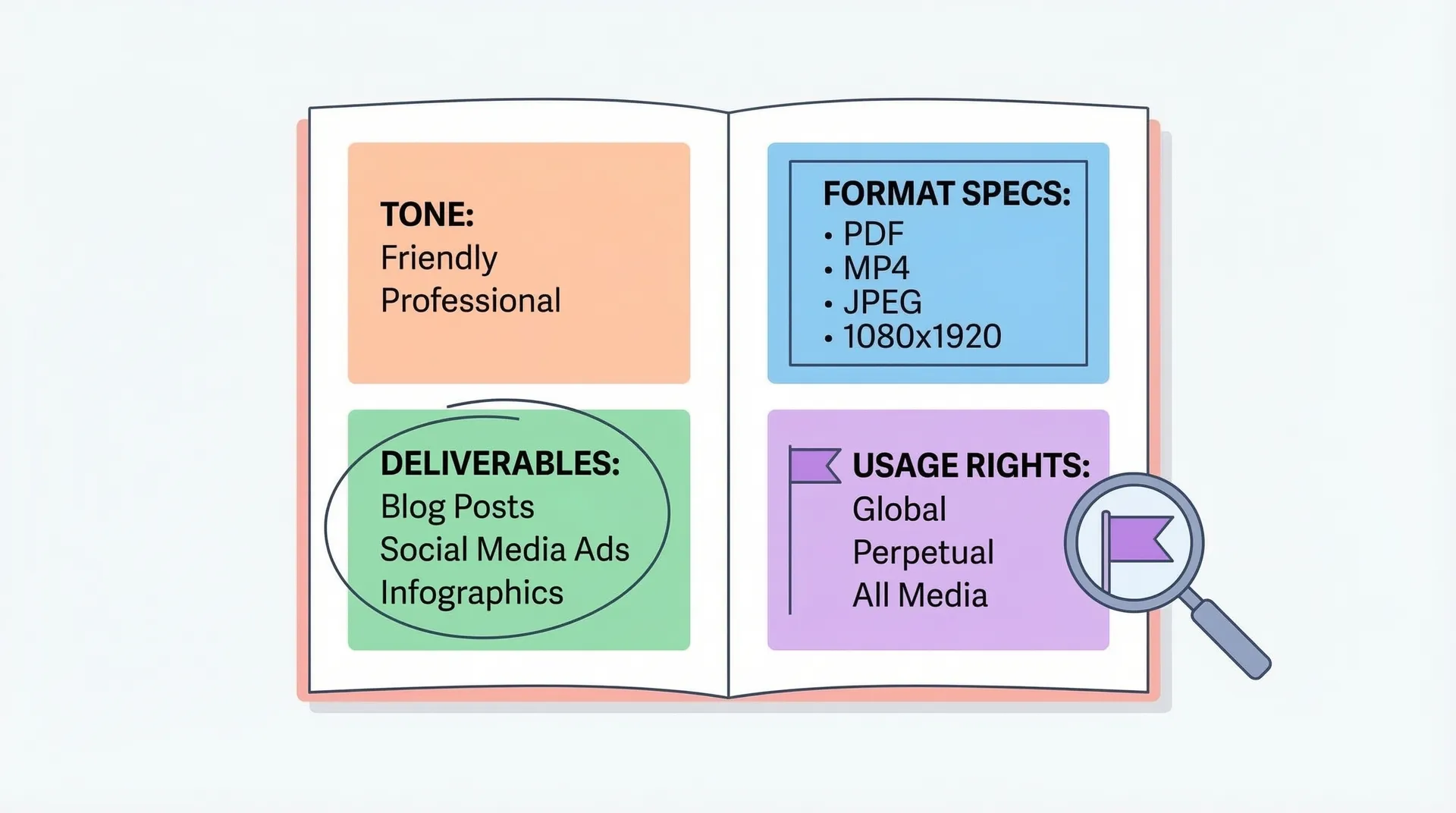
Deliverables tell you what to actually produce. Not the vibe, not the direction — the concrete output. Typical deliverables look like:
- "2x vertical videos, 30–45 seconds each"
- "3x static images + 1x video, unboxing style"
- "1x hero video (60s) + 3x short cutdowns (15s)"
Read it literally. If the brief says two videos, they want two distinct videos — not one long video edited into two clips. If it says "lifestyle" and "tutorial," those are two separate content pieces with different structures.
The part creators miss most: raw files vs. edited deliverables. Some brands want only the final edited video. Others want raw footage too, especially for paid ads — their post-production team will recut it themselves. If the brief doesn't specify, ask before you shoot. Sending back a polished edit when they needed raw clips means a full reshoot.
Also scan for "b-roll requirements" buried in the deliverables section. Brands running paid ads almost always want extra b-roll — product close-ups, hands-on shots, lifestyle cutaways. They're building an ad asset library, not just running one video.
If the deliverables section is ambiguous, email the brand before you shoot. One specific question saves hours of reshoots. Brands appreciate it — it signals professionalism, not weakness.
Format specs: the silent dealbreaker
Brands running paid ad campaigns have strict technical requirements set by their media buyers. If your file doesn't meet spec, it literally cannot run in their ad manager — no matter how good the content is.
Here's what format specs typically cover:
Aspect ratio — The most common are 9:16 (vertical, for TikTok/Reels/Stories), 1:1 (square, for feed), and 16:9 (landscape, for YouTube preroll). Some briefs ask for multiple ratios from the same shoot. Frame your shots wide enough to crop both if that's the case.
Video length — TikTok allows up to 10 minutes now, but Meta ads perform best under 30 seconds. The brief's length requirement is almost always platform-driven. A 15-second cutdown is almost certainly destined for paid Meta ads. Don't treat it as a rough guideline — it's a hard cap set by the brand's media buyer.
File format and resolution — Typically MP4, H.264 codec, minimum 1080p. Sometimes they'll specify minimum bitrate. Check your phone camera settings before you start — default quality is often not max resolution.
Audio — Some briefs specify clean audio with no background music so their post-production team can layer in licensed tracks. Others want you to add music from a specific licensed library. Read this carefully. Adding a trending song when the brief said "no music" means the ad can't run. For more on nailing the technical audio side, UGC audio: how to sound as good as you look covers it in depth — it's the element most creators overlook.
Usage rights: what you're actually agreeing to
This section trips up a lot of creators, mostly because it's written in the driest legal language imaginable. It deserves close attention regardless.
Usage rights define what the brand is legally allowed to do with your content after you hand it over.
Paid amplification / whitelisting — The brand can run your content as a paid ad. This is very different from organic posting. Ads get far more distribution and your face is attached to spend they fully control. Usage rights with paid amplification should command a higher rate — typically 20–40% above your base fee. The FTC's endorsement guidance also has implications here — worth knowing as a creator operating in paid ad territory.
Exclusivity — You agree not to create content for direct competitors during a specified window. Read the definition of "competitor" carefully. A skincare brand might define competitors so broadly it covers half the category you work in. Exclusivity periods of 30–90 days are standard. Anything over six months for a one-off campaign is worth negotiating.
Duration — How long they can use the content. "In perpetuity" means forever. Most brands want this for ad content, which is standard practice. What's not standard is perpetuity rights on organic posts without corresponding pay.
Territory — US-only, global, specific regions. Global rights with paid media usage means your content reaches everywhere they advertise — that's worth more.
If usage rights aren't in the brief at all, that's not a free pass. It means terms haven't been defined — which means you have zero protection if they run your face on a billboard. Always confirm rights in writing before you deliver.
Tone, talking points, and the "do not say" list
The tone section is where briefs most often contradict themselves. "Be authentic and natural" appears in the same document as three mandatory taglines and a list of claims legal hasn't approved.
Here's how to actually use it:
Mandatory talking points — These exist for legal and compliance reasons, not creative ones. Brands in regulated categories (supplements, finance, health) can't let creators make unsupported claims. Read these as guardrails, not a script. Your job is to hit the point in a way that sounds like you said it — not like you're reading from a legal memo.
The "do not say" list — Take this more seriously than the talking points. The "don'ts" almost always come from a specific bad experience — a previous creator who said something that triggered a complaint, a claim that got an ad disapproved, a competitor mention that embarrassed the brand publicly. There's always a reason. Follow it without exception.
Competitor mentions — Almost every brief prohibits them. Don't mention competitor brands even when saying something neutral. Even showing a competitor's packaging in b-roll is a problem for most brands.
Tone words like "playful," "educational," "aspirational" — These are directional, not decorative. If the brief says "educational," lead with a problem and walk through the solution. If it says "aspirational," you're selling a feeling, not a feature list.
Timeline and revision policy
Two things to confirm before you agree to anything:
The due date — Is it the deadline to submit your draft, or the deadline for the final approved version? These are very different. If approval typically takes a week and the go-live date is in five days, you're already behind before you've started. Read "submission deadline" vs. "post date" separately, and if both aren't stated, ask.
Revision rounds — Standard is one to two rounds. Some briefs specify this; many don't mention it at all. If the brief is silent on revisions, set the expectation yourself in your confirmation reply: "Happy to include one revision round in this." That one line protects you from re-doing the content four times for the original fee.
Looking for higher-quality briefs from brands that actually communicate clearly? Best UGC platforms for creators to find paid campaigns breaks down where the serious brand campaigns actually live.
When the brief is vague or confusing
Some briefs are just bad. Vague, contradictory, missing critical information. That's not a reason to guess — it's a reason to ask one clear question before you shoot.
Keep it specific: "The brief mentions two videos — should these be two separate concepts or two versions of the same content framed differently?" That's faster and more professional than a long email cataloging every confusion. One question at a time, wait for the answer, then move.
Brands re-hire creators who make the process easy. Not always the ones who produced the most creative work. Showing up with smart questions before the shoot, delivering on spec, and asking for clear feedback is a repeatable formula that builds a real pipeline. That's covered in depth in how to land your first UGC campaign as a creator — the relationship side of this business matters as much as the production side.
Also useful: checking out how to build a UGC portfolio that wins campaigns so that when brands look you up after a good brief response, what they see convinces them to book you.
The brief is the job spec. Most creators read it once. The ones getting re-hired read it like a contract — because that's exactly what it is.