How to write a UGC script that gets approved fast
A practical framework for writing UGC scripts that match brand briefs, nail the hook, and minimize revision rounds. Stop guessing, start getting approved.

I've watched brands ghost creators — or worse, put them through three rounds of revisions — because the script they submitted bore zero resemblance to what the brief actually asked for. Not because the creator couldn't film well. Not because their delivery was off. Because the script was wrong from the start.
Writing a strong UGC script is the single most overlooked skill in this space. Brands want to approve on the first pass. They don't have time to babysit a rewrite. If you can hand them a script that's already on-brief, concise, and structured the way their ad team thinks — you will get repeat work. That's the game.
Here's the exact framework I use and teach.
Why UGC scripts get rejected (before a single frame is filmed)
Most rejections don't happen in post. They happen the moment a creator sends over a script that runs 90 seconds when the brief said 30. Or opens with "Hey guys!" when the brand asked for a direct hook. Or spends 40% of the runtime on personal backstory instead of getting to the product.
Brands reviewing UGC submissions are usually performance marketers or social media managers with ten other things open. They're not looking for creative interpretation. They want the brief executed — cleanly.
The three failure modes I see constantly:
Wrong length. If the brief says 30 seconds, your script should land at 30 seconds when read aloud at a normal pace. 150 words ≈ 30 seconds. 300 words ≈ 60 seconds. Know your math before you write a single line.
Weak hook. Brands run paid ads. They live and die by the first 2-3 seconds. If your opening doesn't create immediate tension, curiosity, or identification ("I was so sick of waking up exhausted every morning"), the brand will send it back.
Off-brief tone. A premium skincare brand asking for "clean, aspirational content" does not want slang and jump cuts. A Gen Z snack brand asking for "chaotic energy" does not want a composed talking-head delivery. Read the brief twice before writing a word.
The 4-part UGC script structure that works every time
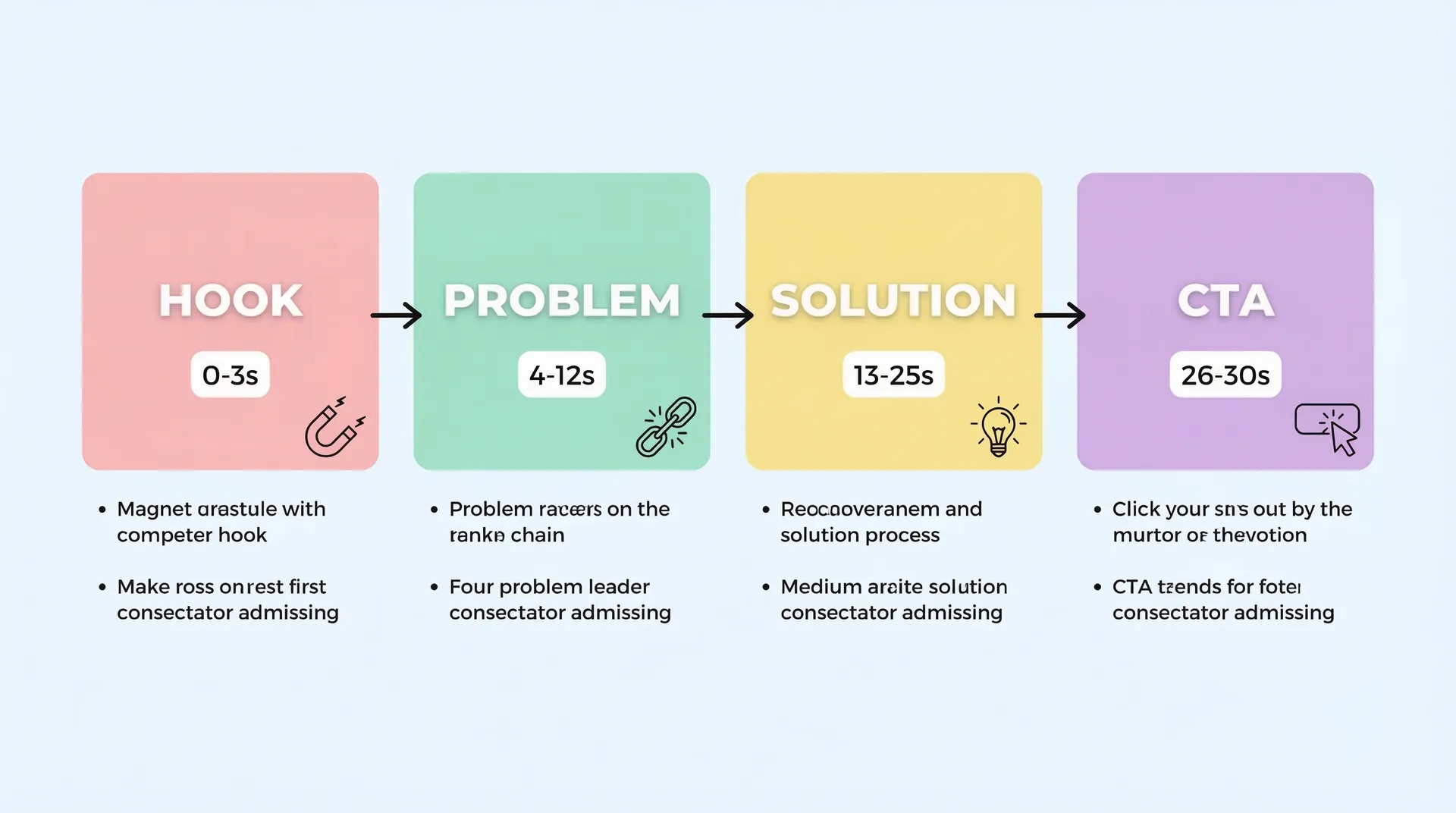
Every high-converting UGC ad I've studied collapses into the same skeleton. Four parts. Every part has a job.
Hook (0–3 seconds)
Your only goal here: stop the scroll. That's it.
Good hooks make a bold claim, surface a pain point, or create curiosity with a visual. Bad hooks start with "Hey, so I wanted to share something with you today." Write 3–5 hook options per script. Let the brand choose, or test them all.
Examples that work:
- "I spent $600 on protein before I found this."
- "My dermatologist actually told me to stop buying serums — here's what she said instead."
- "This thing cleared my skin in 11 days and I'm annoyed I didn't find it sooner."
Notice: no "Hi, I'm [name]." No setup. Straight into the tension.
Problem or Agitation (4–12 seconds)
Make the viewer feel seen. You're not describing a product yet — you're describing their life. If this section resonates, they'll keep watching. If it doesn't, they're already gone.
Keep it tight. One or two sentences. The brief will usually signal which pain point to hit. Use that exact language if the brand provides it. This isn't plagiarism — it's strategy.
Solution (13–25 seconds)
Now you bring in the product. Show it, use it, react to it. This is where you weave in the features or claims the brand listed in the brief — but you translate them into your real-person language, not their marketing copy.
The brief says: "clinically proven to reduce redness in 7 days." Your script says: "I genuinely noticed a difference by day 6."
Same claim. Ten times more credible.
CTA (final 3–5 seconds)
Simple. Direct. Match whatever the brand specified in the brief — "link in bio," "use code [X]," "tap below." Don't freelance the CTA. This is one of the most common places creators go off-brief, and it's an easy fix.
How to map your script to the brief (and avoid revision purgatory)
Before writing a single word, I do a 5-minute brief audit. I highlight:
- Tone descriptors — words the brand uses to describe how they want the content to feel. These become guardrails.
- Required claims or talking points — non-negotiables. Every one of these needs to appear in your script, word-for-word or very close.
- Prohibited content — competitor mentions, certain words, lifestyle associations they're avoiding. Missing these gets you a hard rejection.
- CTA and platform specs — aspect ratio, caption requirements, music guidelines.
If you're not sure how to extract all of this from a brief, the post on how to read a UGC campaign brief breaks it down step by step — it's worth reading before you write anything.
Once you've done the audit, fill in the 4-part structure with the brief's required elements first. Then build around them. The required talking points are anchors. Everything else serves them.
Read your script out loud and time it. Most people write 20–30% longer than they think. Cut ruthlessly — brands will not approve a 45-second script when they asked for 30.
Matching tone: the part most tutorials skip
A script that's structurally perfect but tonally wrong still won't get approved. Tone is harder to teach than structure, but here's a shortcut: go look at the brand's existing ads before you write.
What's their sentence length? Do they use rhetorical questions? Are they formal or conversational? Do they use humor or keep it earnest? Spend 10 minutes on their TikTok or Instagram Reels page and you'll pick up the pattern fast.
Then write in that register. Not your natural voice — theirs.
This sounds basic. Almost no one does it consistently.
Common script mistakes that kill first-pass approvals
Writing for performance, not for approval. Your script goes through a brand reviewer before it goes in front of a camera. Optimize for the person who reads it, not the viewer who watches it — at least on the first pass.
Burying the product. I've seen scripts where the product name shows up at the 45-second mark in a 60-second video. Brands hate this. The product should be named or shown by the end of the problem section at the latest.
Over-scripting the B-roll. Don't describe every shot in granular detail unless the brief specifically asks for a shot list. Brands want to see your script content — they trust you to handle the production decisions.
Ignoring the hook entirely. Some creators treat the hook as a throwaway opener. Brands doing paid performance know that hook testing drives most of their ROAS variation. They take it seriously. You should too.
A note on script length and pricing
The deeper I got into UGC, the more I realized that script quality is directly tied to what you can charge. Creators who submit polished, on-brief scripts with multiple hook variations get reordered. Creators who need three revision rounds often get replaced.
If you're still figuring out what to charge for different deliverables, the breakdown at UGC creator rates: what to charge for videos and photos is a good reference. Script revisions are often where pricing conversations get messy — know your boundaries before they come up.
And if you want to see how scripting fits into the broader picture of winning campaigns, the pillar post on how to land UGC campaigns as a creator in 2026 covers the full funnel from pitch to payment.
A simple UGC script template you can use today
Here's a fill-in-the-blank structure for a 30-second script:
[HOOK — 1 sentence, 0-3s] State the pain, make a claim, or create curiosity.
[PROBLEM — 2-3 sentences, 4-12s] Describe the before state in specific, relatable terms.
[SOLUTION — 3-4 sentences, 13-25s] Introduce the product, name it, describe one or two key results using the required talking points from the brief.
[CTA — 1 sentence, 26-30s] Use the exact CTA format the brand specified.
That's your skeleton. Now fill it in with the brief's required claims, your own voice, and a hook that earns those first 3 seconds.
Always submit at least 2 hook variations with your script. It shows professionalism, gives the brand optionality for A/B testing, and often gets you approved faster because they feel like they have creative control.
Once your script gets approved, make sure you've got the rest of your paperwork sorted — particularly around usage rights and deliverable specs. The UGC contract template post covers exactly what should be locked in writing before you hit record.
And if you're just starting to find campaigns worth scripting for, the best UGC platforms for creators is a good place to look for live briefs right now.
Frequently Asked Questions
How long should a UGC script be?
What is the structure of a UGC script?
How do I write a UGC hook that gets approved?
Should I include B-roll directions in my UGC script?
How many revision rounds should I expect for a UGC script?
Can I use the same UGC script structure for different platforms?
Related reading
- How to read a UGC campaign brief (and what brands want)
- How to land UGC campaigns as a creator in 2026
- UGC creator rates: what to charge for videos and photos
- UGC contract template: what to include before you film
- How to pitch brands for UGC: cold outreach templates
- Best UGC platforms for creators to find paid campaigns
- UGC audio: how to sound as good as you look