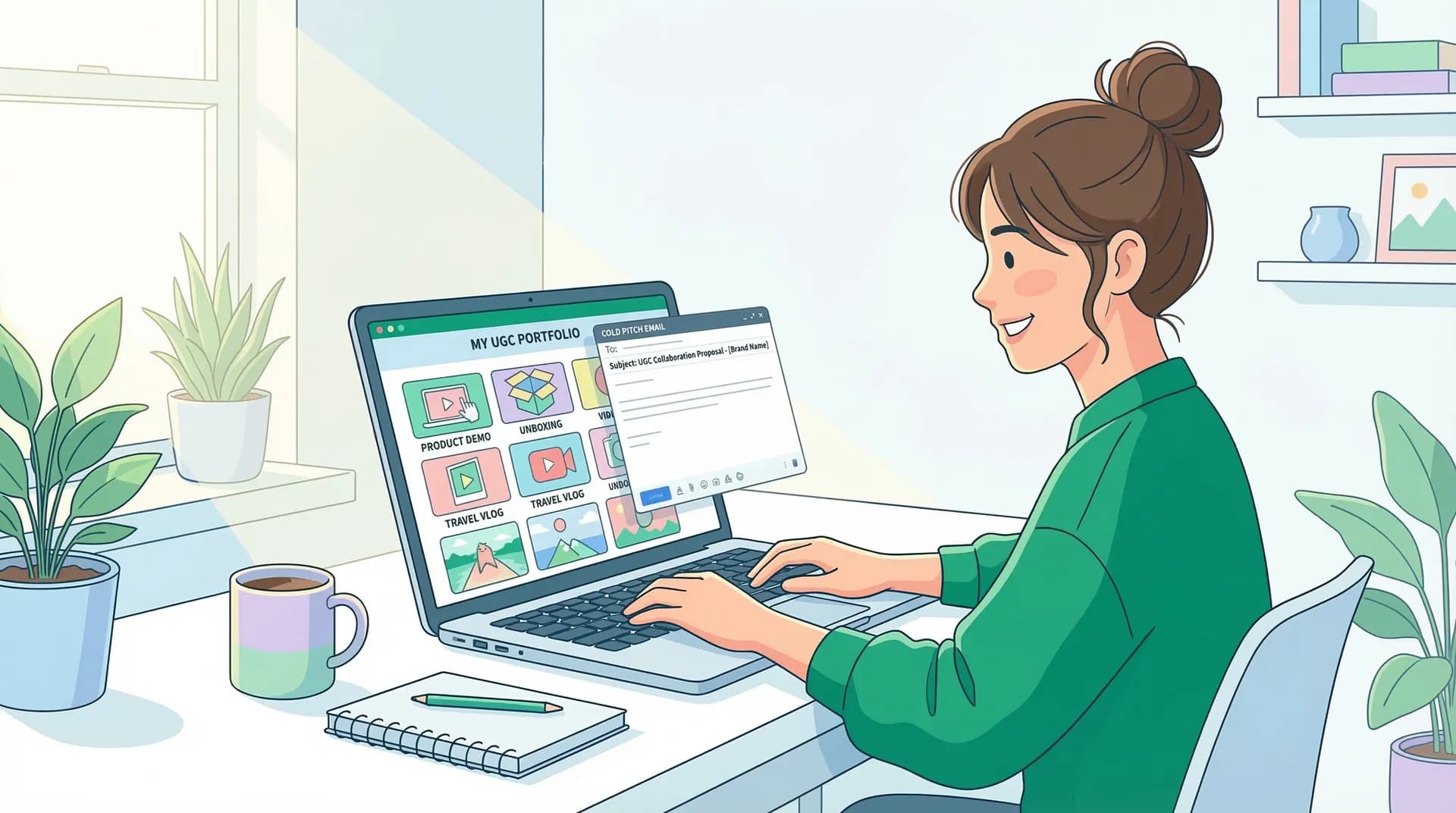
How to pitch brands as a UGC creator: email templates
Exact cold email and DM templates to pitch brands as a UGC creator, with portfolio presentation tips that get more replies and land paid deals.

My first brand reply came from a portfolio link, not the pitch copy. I'd sent 40+ cold emails with the same opener — "Hi, I'm a UGC creator and I'd love to work with your brand." Crickets. Then I rewrote one email and did something different: I led with a portfolio link and said exactly what I could make for them. Three replies that week.
The portfolio was the pitch. The email was just the wrapper.
Most creators flip this completely. They write long, polished emails about their follower count and creative philosophy, then bury the portfolio link at the bottom. That's backwards. Brand managers aren't reading three paragraphs about your creative process. They're skimming for one thing: can this person make content that looks like it could run as an ad?
Why pitching as a UGC creator is different
Brand managers and marketing teams get dozens of creator pitches per week. Most of them are about the creator. Their audience. Their aesthetic. Their "unique voice."
None of that is what a brand needs to know in the first email.
UGC is a services business. You're a freelance creative, not an influencer pitching a sponsored post. The brand doesn't care about your follower count — they're not buying reach. They care about two things: can you make content that converts, and is it easy to work with you.
Your portfolio answers both questions. A good portfolio page shows the quality of your work immediately. A strong pitch email says: "Here it is, here's what I'd make for you, and here's how to hire me." That's the entire formula.
Before you send anything, make sure your portfolio is actually ready to do that job. If you're still building it out, How to build a UGC portfolio that wins brand deals covers the full structure — from what to include to how brands evaluate what they see.
The anatomy of a portfolio-led pitch email
Short subject line. Opening line that signals you know something about them. One line about your work. The portfolio link. A specific, low-friction CTA.
Five elements. Under 150 words.
Most creators treat cold pitches like cover letters. You don't need to explain your entire background. You need to get a brand manager to click a link and watch 30 seconds of video. Everything else can wait for the call.
What kills replies before they happen:
- Starting with "I hope this email finds you well"
- Listing your follower stats in the opening (nobody cares yet)
- Attaching files instead of linking to a hosted portfolio
- Making the ask too big ("let's hop on a 45-minute discovery call")
The goal of the first email is singular: get them to click your portfolio link. That's it.
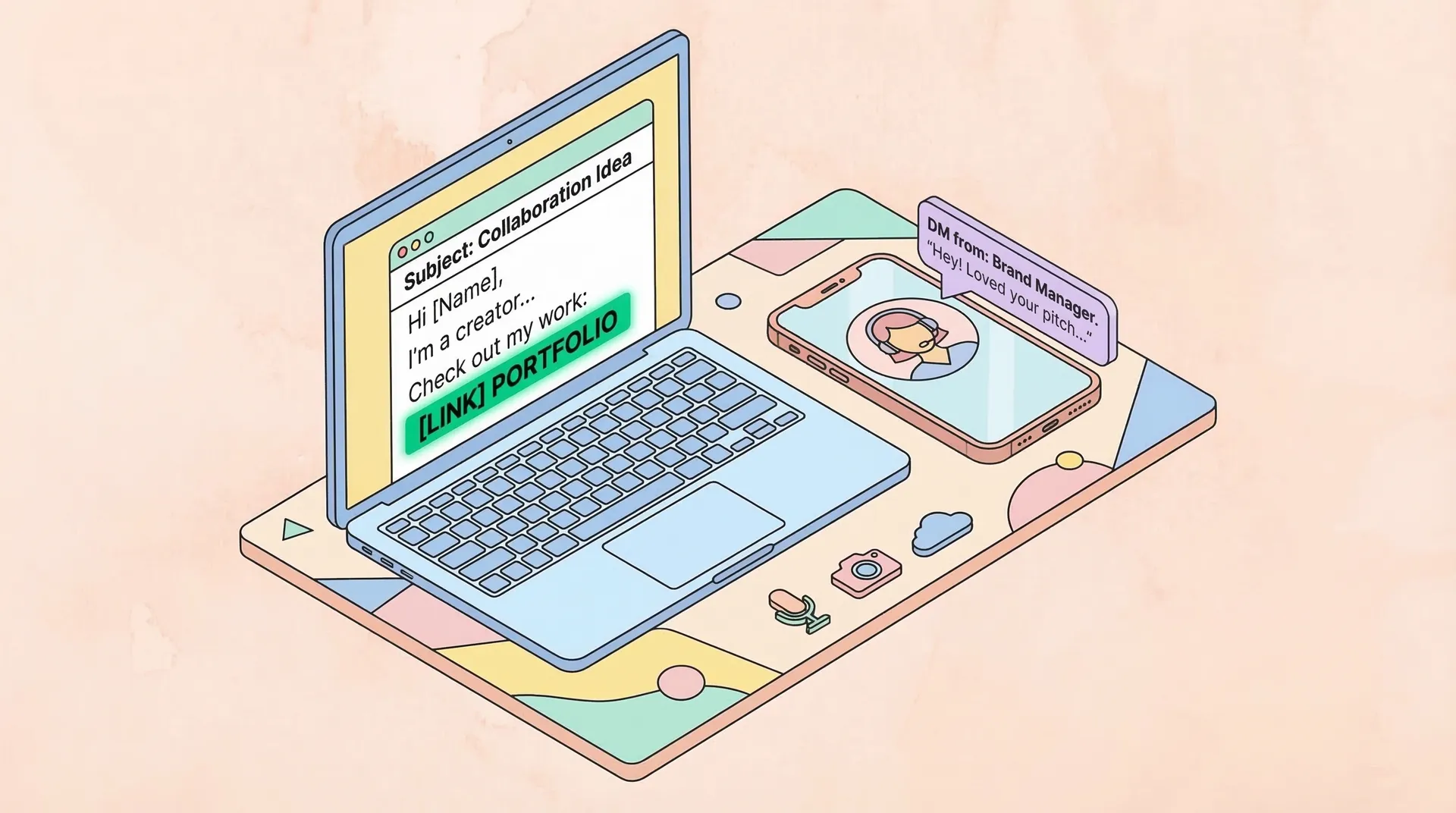
Cold email templates for UGC creators
These are frameworks, not scripts. Personalize the brackets before sending — but keep the structure tight.
Template 1 — The "I Already Made Something" approach
Best for brands you're genuinely a customer of. High credibility, low friction.
Subject: [Brand Name] content — made a few clips on my own
Hi [First Name],
I've been using [Product] for the past [X months] and shot a few UGC-style clips off my own bat. They're the kind of casual, authentic content that tends to perform well in Meta and TikTok ads.
Here's my portfolio — the [Brand]-style clips are in the [niche] section: [portfolio link]
They're yours to use. If you like the style, I'm available for a paid batch — [X] videos starting at $[rate], delivered in 5–7 business days.
Worth a look?
[Your name]
Template 2 — The "I Researched You" approach
Best for brands you've specifically studied but haven't used personally.
Subject: UGC content for [Product Category]
Hi [First Name],
I noticed [Brand] is [recently launched X / running ads for Y / expanding into Z]. I create UGC for [niche] brands — here's my recent work: [portfolio link]
I specialise in [testimonial-style videos / unboxing demos / lifestyle content] and can produce [number] deliverables in [timeframe] at $[rate] per video.
Would content like this fit what you're building right now?
[Your name]
Template 3 — The "Social Proof" approach
Best when you have one recognisable client to reference.
Subject: UGC for [Brand] — worked with [Similar Brand]
Hi [First Name],
I'm a UGC creator who recently produced content for [Brand Name in same niche]. Portfolio here: [portfolio link]
If you're looking for content that doesn't look like an ad but performs like one, I'd love to put a proposal together.
[Your name]
On personalisation: You don't need to write 40 unique emails. You need 3–4 solid templates and 2–3 personalised sentences per brand. Research what product they're pushing, what their current ads look like, and whether they're a Meta or TikTok-first brand. That context goes in the opening line. Everything else stays templated.
DM scripts for Instagram and LinkedIn
Cold DMs have a lower reply rate than email, but they work for brands that don't have a public marketing contact address. Keep them extremely short — under 80 words.
Instagram DM:
Hey [First Name], I create UGC for [niche] brands and your product caught my eye. I've made content for similar brands — quick look here: [portfolio link]. Happy to send a custom pitch if it's a fit.
LinkedIn message (for brand managers and marketing leads):
Hi [Name], I'm a UGC creator who works with [niche] brands on short-form ad content. I think [product/brand] would be a great fit for what I do — portfolio here: [link]. Open to a chat if the timing works.
Portfolio link placement matters even more in DMs than in email. Put it in the second sentence, not the last. People read the first line and decide whether to keep scrolling. Prove you have the goods before you ask for anything.
Follow-up scripts that don't feel desperate
Send one follow-up, 5–7 days after your original email. No reply after that? Move on. More quality pitches will always outperform chasing cold leads.
Follow-up template:
Hi [First Name],
Just bumping this up in case it got buried. Portfolio link again: [link]
Happy to put together a 2–3 clip sample brief if it's easier to see something specific to [Brand's product type]. No commitment needed.
[Your name]
Two things make this work: it leads with the portfolio link again rather than rehashing the original email, and it reduces friction by offering a sample brief instead of jumping straight to a paid deal.
Matching your pitch to the brand
Not every brand needs to see your full portfolio. The exact sections brands want in a UGC portfolio covers the full structure, but for pitching purposes: send the most relevant work first.
If you're pitching a skincare brand, open with your skincare videos. Your fitness content isn't relevant — don't include it. Create separate portfolio views by niche, or build multiple landing pages if you work across categories. The fastest way to lose a deal in the first email is to make a brand scroll through irrelevant content before they find something that fits.
A few things that measurably improve reply rates:
- Show results when you have them. "This ad hit a 4.2% CTR on Meta" is worth more than ten uncontextualised clips.
- Keep load time under 3 seconds. Brand managers check pitches on phones. A slow portfolio website costs you deals before anyone watches a single video.
- Include your rate range. Brands appreciate knowing if you're in their budget before committing to a conversation. Here's how to display UGC rates inside your portfolio without putting people off.
If you're still figuring out what to charge, UGC creator rates: what to charge for videos and photos breaks down the numbers by deliverable type.
Common pitch mistakes that kill replies
Pitching via the brand's general contact form. It goes nowhere. Find the marketing manager or brand partnerships lead on LinkedIn and reach out directly.
Leading with your follower count. UGC isn't influencer marketing. If your opening line mentions "12K followers," you're signalling that you don't understand what you're selling. Brands buying UGC are buying creative output, not reach.
Not having a mobile-optimised portfolio. Seriously — test yours on a phone right now. If it's slow, hard to navigate, or doesn't autoplay videos, fix that before your next pitch batch.
Over-explaining in the first email. Nobody reads four paragraphs from a stranger. If you need four paragraphs to justify your value, the portfolio isn't working hard enough. Fix the portfolio, then shorten the email.
Pitching too broadly. Ten pitches to brands in one niche — with hyper-relevant samples — will outperform 100 generic emails every time. Niche down, make the portfolio relevant, get replies.
For creators still putting their portfolio together, resources like building a UGC portfolio in Canva and how to build a portfolio with no experience are worth the time before you start your outreach push.
Frequently Asked Questions
How do I pitch brands as a UGC creator with no experience?
Should I attach my portfolio as a PDF or link to it?
How long should a UGC pitch email be?
How many brands should I pitch per week as a UGC creator?
What's the best way to find brand contact emails for UGC pitches?
How do I follow up on a UGC pitch without being annoying?
Related reading
- How to build a UGC portfolio that wins brand deals
- UGC portfolio template: the exact sections brands want
- How to display your UGC rates inside your portfolio
- 15 UGC portfolio examples that actually land brand deals
- How to negotiate brand deals: scripts and tactics that work
- UGC creator rates: what to charge for videos and photos