
UGC collaboration vs. influencer post: what's the difference
Understand the real differences between a UGC collaboration and an influencer post so you know exactly what you're agreeing to before signing anything.

I've watched creators sign what they thought was a ugc collaboration — then quietly realize they'd agreed to post the content on their own account, grant 18 months of full advertising rights, and redo the video free of charge if the brand wasn't happy with take one. That's not a UGC deal. That's an influencer post with a UGC label stapled to the front.
The industry conflates these two things constantly. And when brands do it on purpose, it costs creators real money.
Here's how to tell the difference, what the contracts actually say, and how to price yourself correctly once you know which deal you're actually being offered.
What a UGC collaboration actually is
In a genuine ugc collaboration, you are a content producer. Full stop. The brand is purchasing your creative output — a raw video, a polished testimonial clip, a lifestyle photo set — and they will use that content in their own marketing channels. Their paid ads, their website, their email sequences. Your deliverable ends when you hand over the files.
Your follower count doesn't come up. Your engagement rate doesn't matter. Whether you have 400 followers or 400,000 is completely irrelevant to the transaction. What they're buying is whether your content converts.
What you're actually delivering in a UGC deal:
- Finished video files (usually 9:16, anywhere from 15 to 60 seconds)
- Raw footage for their in-house editors, or final edited deliverables depending on the brief
- A license granting the brand rights to run your content as paid media
No posting on your own account required. You film, you deliver, they run it.
What an influencer post actually is
An influencer deal is built entirely on your audience. The brand isn't buying content in isolation — they're buying access to the people who follow you, trust your recommendations, and purchase things because you said so.
You post to your own account. Your reach is the product. Your average views, your demographic breakdown, your engagement rate — those are the numbers that determine your rate. This is a completely different transaction.
When a brand offers a "paid partnership," a "sponsored post," or asks you to include a specific hashtag with a tag to their account — that's an influencer deal. You're not just making content. You're distributing it through your platform to your community.
Why brands are shifting budgets from influencers to UGC creators explains the macro shift well, but the key point for this conversation is simple: these are two separate services. Brands know that distinction. The question is whether you do before you sign.
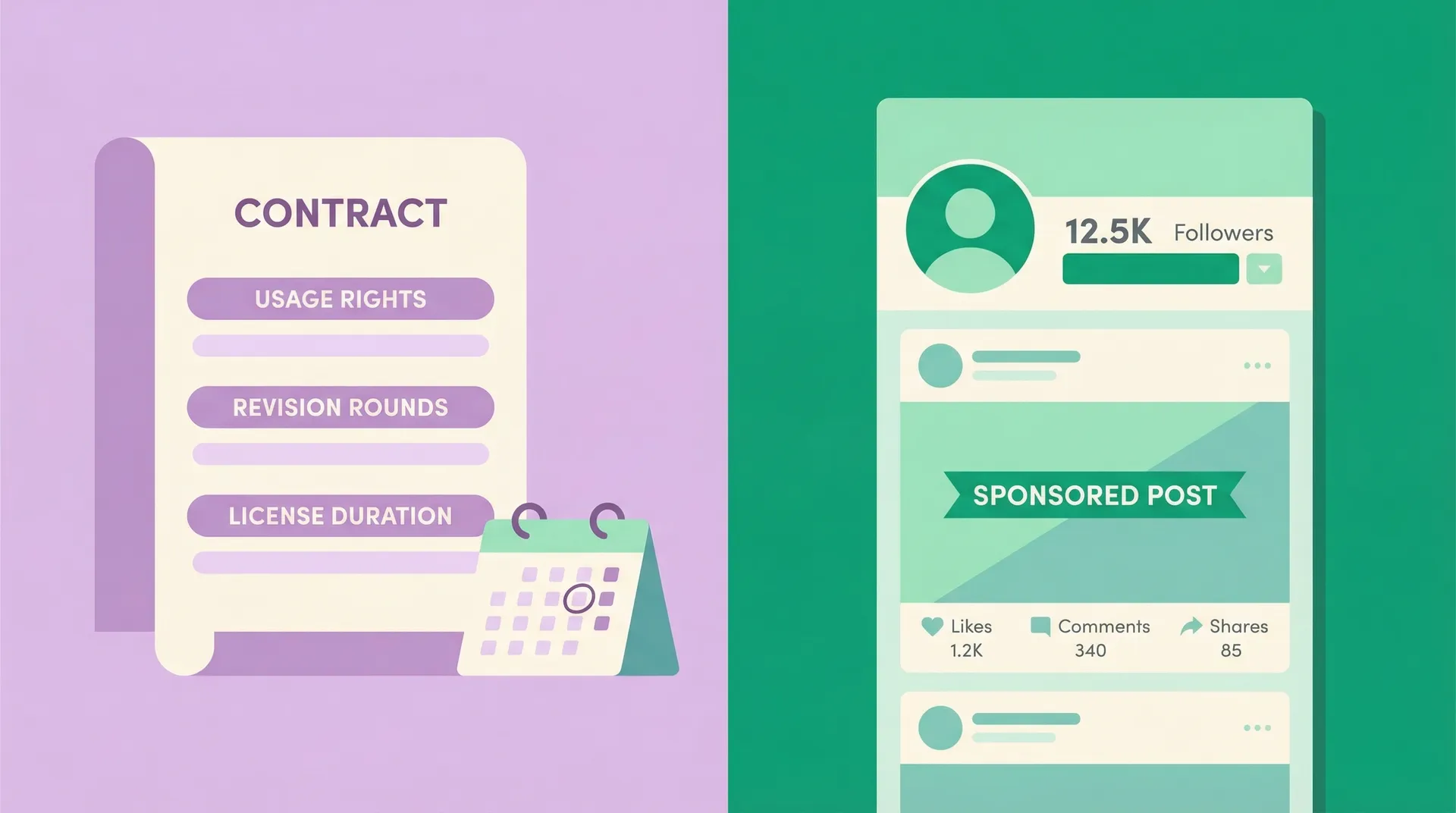
The contractual differences that will affect your bank account
This is where creators get hurt. The language in a brief or agreement often reveals which deal type you're actually looking at — if you know what to look for.
Usage rights and licensing
UGC contracts always include usage rights language. You're granting the brand a license to use your content — typically for 6 months, 1 year, or in some cases perpetual. The broader and longer the license, the higher your rate should be. A brand paying $250 for a video they plan to run as a TikTok ad for 18 months is getting a steal. Understanding how to price UGC licensing and usage rights properly is one of the fastest ways to significantly increase your income.
Influencer contracts are structured differently. They focus on posting requirements: which platform, when to publish, caption copy or guidelines, mandatory disclosures, and often how long the post must remain live before you can archive or delete it.
Exclusivity clauses
Both deal types can carry exclusivity. But the scope differs. In a UGC deal, exclusivity typically means you can't create content for direct competitors for a defined period — usually 30 to 90 days. In an influencer deal, exclusivity also means your audience can't see you working with competing brands. That's a more serious restriction on your earning potential, and it should be priced accordingly.
The window matters enormously. Thirty days is standard. Ninety days is getting expensive. Six months is aggressive and warrants significant additional compensation. Our UGC contract template guide walks through every clause worth understanding before you ever press record.
Whitelisting and creator licensing
This one catches newer creators off guard consistently.
Some brands want to run your content as a paid ad directly from your own account — this is called whitelisting, or creator licensing on Meta's ad platform. They'll request access to your Business Manager and run the post as if it's organic content coming from you. The ad shows your name, your face, your profile.
Whitelisting is not standard in a UGC deal. It's an influencer-tier feature with reach and authenticity baked in. If a brand's contract mentions whitelisting, boosting, or ad account access — that's a premium add-on. Price it like one.
Revision rounds
UGC contracts almost always cap revision rounds — typically one or two rounds of changes. Influencer contracts rarely specify this, because the brand is trusting your creative judgment to produce content your audience responds to.
If a contract says nothing about revisions, add your own clause before signing: after two rounds, additional revisions are billed at an hourly or per-revision rate. You don't want to be refilming a product demo for the sixth time because a brand can't decide on their messaging.
Creative deliverables: what you're actually making
UGC briefs are more prescriptive. The brand tells you exactly what to say, how long the video should run, which hook to open with, and sometimes lists specific B-roll shots by name. You're executing their vision, not expressing yours. That's fine — but it means reading the campaign brief thoroughly before you film, not after you've already shot three takes.
Influencer content gives you more latitude because your authentic voice is the actual product. A sponsored post that looks exactly like a brand's own ad creative will underperform on your channel — your audience will sense it immediately, and it erodes trust. Brands with experience in influencer marketing know this and usually say so explicitly.
Production expectations diverge here too. UGC content often mimics the low-fi, handheld, "real person" aesthetic that performs in paid ads — but it still has to convert. A strong opening hook is non-negotiable regardless of the deal type. Developing your ability to write a scroll-stopping UGC hook pays dividends on both sides of this equation.
Influencer posts tend to be more considered aesthetically because they sit on your profile — sometimes permanently. Your brand identity is attached to them.
Which one are you actually being offered?
Use these as a quick filter when a brand inquiry lands in your inbox or you're browsing a campaign on a platform:
It's a UGC deal if:
- The brief says "content for ads," "ad creative," or "content only, no posting required"
- They don't ask about follower count, engagement rate, or audience demographics
- Payment isn't tied to views, reach, or performance metrics
- They want files delivered to a Dropbox or email, not a live post published
It's an influencer deal if:
- They ask for your stats, media kit, or audience breakdown upfront
- They want a published post with specific hashtags, tags, or a disclosure label
- Performance metrics like CPM, reach, or impressions are referenced
- They specify how long the content must stay live on your account
Hybrid deals exist — you create the content and post it on your account. That's two services. It should be priced as two services. When you apply for UGC campaigns, knowing which category a campaign falls into lets you evaluate the rate before you apply rather than negotiating blind after you're selected.
If you can't tell from the brief, ask directly. Any professional brand or agency will clarify. If they dodge the question or give a vague non-answer, pay attention to that.
Getting this right before you agree to anything
Brands that specifically seek out UGC creators through platforms and marketplaces are buying content production skills. Not audience reach. That reframe matters: your follower count shouldn't be driving your rate in a ugc collaboration — your content quality should.
That said, some brands deliberately obscure this distinction. They use "UGC creator" language to underprice what is functionally an influencer deal. Watch for it. If a brand wants you to post on your account, promote it to your followers, and hand over usage rights for their paid ads — you're doing two separate jobs. Charge for both.
If you want the full picture on finding, evaluating, and landing paid deals — not just understanding what type of deal you're looking at — how to land UGC campaigns as a creator in 2026 covers the entire process. The distinction between a UGC collaboration and an influencer post is the foundation. Building a strategy on top of that foundation is what turns sporadic brand deals into consistent income.
Frequently Asked Questions
What is a UGC collaboration?
What's the difference between a UGC creator and an influencer?
Do UGC creators have to post on their own accounts?
What is whitelisting in a UGC deal?
How many revision rounds should a UGC contract include?
Can I negotiate UGC collaboration terms?
Related reading
- How to land UGC campaigns as a creator in 2026
- How to apply for UGC campaigns and actually get selected
- UGC contract template: what to include before you film
- UGC creator rates: what to charge for videos and photos
- How to read a UGC campaign brief (and what brands want)
- Best UGC platforms for creators to find paid campaigns
- Why brands are shifting budgets from influencers to UGC creators