UGC contract template: what to include before you film
Every UGC contract needs usage rights, revision limits, payment terms, and an exclusivity window. Here's exactly what to include — and what to push back on.

A UGC creator I know shot a product video for a skincare brand in January 2024. Got paid $350. The agreement was a quick back-and-forth over Instagram DM — "two videos, $350 total, post within the week."
Eighteen months later she found those exact clips running as paid Meta ads. The brand had repurposed her footage across their entire funnel: Stories ads, feed ads, dark posts. She had no recourse. No usage fee. Nothing enforceable in writing.
That's not a horror story. That's just what happens when you film without a proper UGC contract template.
I've watched this from both sides — as a creator and now building Crelio.app, a platform creators use to manage campaigns and brand deals. The pattern is always identical: the creators getting burned are the ones who treated the paperwork as optional. The ones earning $3,000–$8,000/month consistently treat their contracts as seriously as their creative.
Here's exactly what to put in yours before you film a single second of footage.
Why your ugc contract template matters more than your creative
Brands aren't going to hand you a balanced contract. Most send you a brief, a product shipment, and an implicit expectation that you'll "just figure out the details." Some send their own agreements — written entirely in their favor, designed to be skimmed and signed.
The answer isn't a lawyer on retainer. It's six clearly defined clauses that protect your time, your IP, and your income.
If you're still building your campaign pipeline, start with how to land UGC campaigns as a creator in 2026 — but come back here before you say yes to anything.
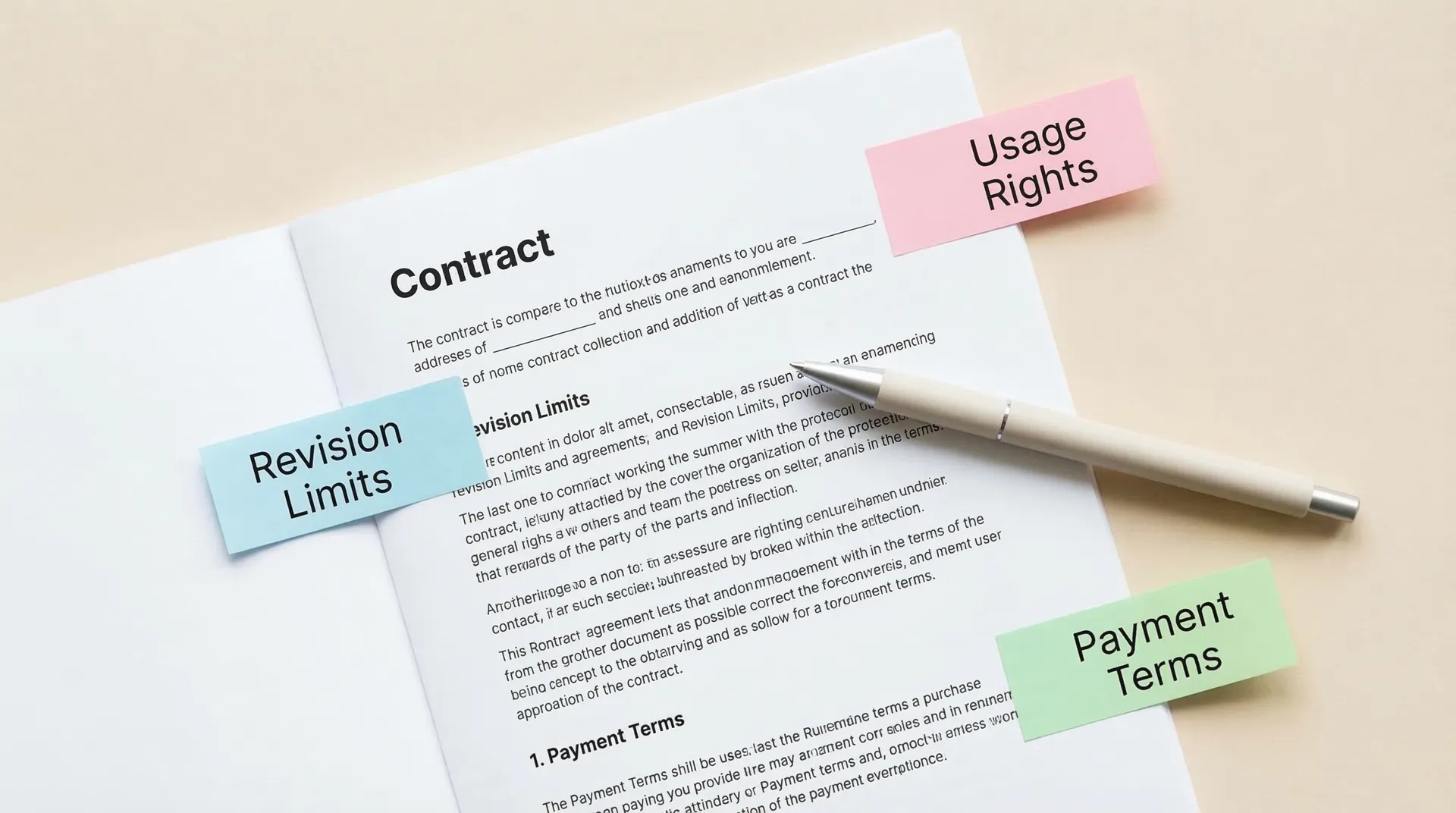
The 6 clauses every UGC contract needs
1. Deliverables spec
Be specific to the point it feels excessive. It won't feel excessive when a brand asks for a seventh revision because you "didn't specify the maximum."
Your deliverables section should include:
- Number of videos and/or images
- Aspect ratios and dimensions (9:16, 1:1, 16:9 — all of them if applicable)
- Length range per video (e.g. 15–30 seconds, 30–60 seconds)
- Platform context — TikTok, Reels, YouTube Shorts have different best practices
- Whether raw or unedited footage is included (it usually shouldn't be, unless priced for it)
If the brand's brief is unclear on any of this, read how to read a UGC campaign brief before you start negotiating deliverables.
2. Usage rights
This is the clause that costs creators the most money when it's vague.
"Social media usage" is not a usage right. It's a placeholder. A video running as an organic post on @brandname for 30 days and that same video running as a paid ad across Meta, TikTok, and YouTube for 12 months are two entirely different products. Price them differently.
Your usage rights clause needs to specify:
- Platforms: Organic social only? Paid ads? Website embed? Email campaigns? Dark posts? List each one explicitly
- Duration: 3 months, 6 months, 12 months, perpetual. Perpetual is almost always a hard no unless the rate accounts for it
- Geographic scope: US-only or worldwide?
- Sub-licensing: Can the brand share your content with affiliates, partners, or agencies? That should cost more
Brands running paid ads will want a longer window. That's fine — but longer windows cost more. I've gone deep on exactly how to price this in UGC usage rights: how to price licensing fees.
3. Revision limits
Two rounds of revisions is the industry standard. Write it down.
Also define what a revision actually means. A minor color correction and a complete script rewrite are not the same thing. Structural changes — new b-roll, refilmed hooks, different messaging — should be billed separately.
A clause I've used repeatedly: "Two rounds of revisions are included. Each additional round is billed at 20% of the original project fee, minimum $75."
That single line has saved me from multi-week revision spirals with indecisive brand managers more times than I can count.
4. Payment terms
Don't rely on goodwill. Get the payment structure in writing, with specific dates.
Standard structure for UGC:
- 50% upfront before filming begins — especially for new clients
- 50% on delivery or within 7–14 days of final approval
- Late payment clause: 1.5–2% per week after the due date, or a flat fee per week overdue
Specify: the currency, the payment method (PayPal, bank transfer, etc.), and the exact invoice date. "Payment upon approval" is not a date. It's an opportunity for delays.
If the idea of asking for 50% upfront feels uncomfortable, you might be undercharging. Check UGC creator rates: what to charge for videos and photos to calibrate.
5. Exclusivity window
This is separate from usage rights. Exclusivity governs what you can't do — not what they can use.
If a protein powder brand wants you to avoid working with any competing supplement brands during their campaign, that's a real restriction on your income. Charge for it.
Define it precisely:
- Which competitor categories are off-limits?
- How long does exclusivity last? (30–90 days is typical for single campaigns)
- Does it apply to organic content, paid deals, or both?
Blanket exclusivity with no end date is not a deal. It's an unpaid retainer. Push back every time you see one.
6. Kill fee
A kill fee protects you if the brand pulls out after you've started work.
Standard: if the project is cancelled after filming begins but before delivery, you keep 50–100% of the agreed fee depending on how far along you are.
Write this in. Startups especially will cancel projects mid-campaign when priorities shift or budgets get cut. Without a kill fee clause in your UGC contract, you've just donated your time to a company's Q3 budget crisis.
Red flags in brand contracts you should push back on
Sometimes brands send their own agreements first. Read them carefully. These clauses appear regularly and they're worth fighting:
Perpetual, royalty-free, worldwide usage — Often buried in boilerplate. It means they can use your content forever, everywhere, for free. Counter with a 12-month license and a negotiated renewal option at a stated rate.
"Work for hire" — Under US copyright law, work-for-hire transfers all IP to the brand, including the creative idea itself. It's aggressive for UGC. If they insist on it, double your rate minimum.
No revision cap — No cap means unlimited revisions. You agreed to that. Add your own clause specifying two rounds maximum before countersigning anything.
"Net 60" payment terms — Net 60 means you wait two months for money on work already delivered. Push for net 14–30 and add a late payment clause.
"Payment upon brand approval" with no approval deadline — This one is subtle. If approval never comes, payment never comes. Set an explicit approval window — 10–14 business days — after which the deliverable is considered approved and payment is due.
If you want to set expectations before contracts even come into the picture, how to pitch brands for UGC covers the upfront conversation where you establish how you work.
How to send a contract without making it awkward
Most creators skip the paperwork because they're afraid of seeming difficult or "too serious" for a small deal.
You're not being difficult. You're running a business. Any brand that pushes back on a straightforward agreement covering deliverables, usage, and payment is telling you something important about how the rest of the engagement will go.
The framing I use: "I'll send over a simple agreement that covers deliverables, usage, and payment timeline — just so we're both clear going in."
That's it. No apology. No "I hope this is okay." Send it like it's obvious, because it should be.
Tools like DocuSign or HelloSign work well. A clear Google Doc PDF confirmed by email is also enforceable in most disputes if you keep the thread. You don't need expensive software when you're starting out.
Before signing anything, it's worth reading the FTC's endorsement guidelines — especially if the brand intends to run your content as paid advertising. Disclosure requirements shift depending on how the content is used.
Rates and contracts are one system, not two separate things
Your contract and your pricing aren't independent. They work together or they don't work at all.
If you charge $300 for a video and your contract allows 12 months of paid ad usage across all platforms, you've just charged $25/month for professional ad creative. Brands pay agencies $1,500–$5,000/month for that same output. You're underpricing by an order of magnitude.
Build your rates to reflect the usage rights you're signing off on. When a brand wants to extend beyond the original agreement, that's a renewal — new invoice, new terms. Not awkward. Normal.
The creators who are still doing this in three years aren't necessarily the most talented. They're the ones who showed up with a contract.
Frequently Asked Questions
Do I need a lawyer to write a UGC contract template?
What usage rights should I include in a UGC contract?
How many revisions should a UGC contract allow?
Should UGC creators ask for payment upfront?
What is a kill fee in a UGC contract?
What is a reasonable exclusivity window for UGC creators?
Related reading
- How to land UGC campaigns as a creator in 2026
- UGC creator rates: what to charge for videos and photos
- How to pitch brands for UGC: cold outreach templates
- How to read a UGC campaign brief (and what brands want)
- UGC usage rights: how to price licensing fees
- Best UGC platforms for creators to find paid campaigns