
UGC creator contract: clauses that protect your pay
The key clauses every UGC creator contract needs: payment terms, kill fees, revision limits, and usage rights. Stop getting ghosted after you film.

A $1,200 video. Two full days of filming. Three rounds of edits. Then the brand went quiet.
Three weeks later I saw the video running as a paid Facebook ad. No payment. No email. Just my face, their product, their ads account.
I had no contract. Nothing but a DM thread with a price agreed in emojis. Zero leverage.
That was the last time I worked without a solid UGC creator contract in place.
The frustrating thing is that most creators who get burned aren't naive — they just don't know which specific clauses actually protect them. A vague agreement that says "content delivery by Friday" doesn't protect you from anything. The right clauses do.
The ugc creator contract brands send you isn't written for your benefit
When brands send a contract — and many don't bother — it's their legal team's document. It grants them perpetual global rights to your content. It asks for unlimited revisions "until approved." It pays net-30 or net-60. And if they decide they hate the final product, they keep it.
Signing that as-is means you're working under someone else's terms. Which is fine for employees. You're not an employee.
A proper ugc creator contract protects four things: when you get paid, how many revisions you'll do, what happens if they cancel, and exactly what rights they're buying. Get all four locked in and you'll stop chasing invoices.
If a brand refuses to sign any written agreement before you film — not a red flag, a dealbreaker. Walk away. Legitimate brands understand contracts protect both sides.
Payment terms: the clause most creators get wrong
"We pay net-30" sounds professional. It's also how brands hold your money hostage for a month after you've already done all the work.
Here's what I put in every contract now: 50% upfront, 50% on delivery. Non-negotiable for new brand relationships. The deposit does two things — it filters out time-wasters before you spend a day filming, and it means you're never completely exposed if things go sideways.
The payment clause should also specify:
- Payment method — Bank transfer, PayPal, Stripe. Be specific. "Standard payment method" means nothing if you end up arguing about Venmo fees three weeks later.
- Due date — "Within 5 business days of final delivery" is cleaner than net-30. Fewer ways to interpret it, fewer ways to delay it.
- Late fees — I charge 1.5% per month on overdue invoices. It's mild, but it signals you track these things and expect to be paid.
For ongoing brand relationships, the payment structure shifts. Monthly retainer deals have their own cadence — upfront monthly billing works better than per-video payment when you're delivering content weekly.
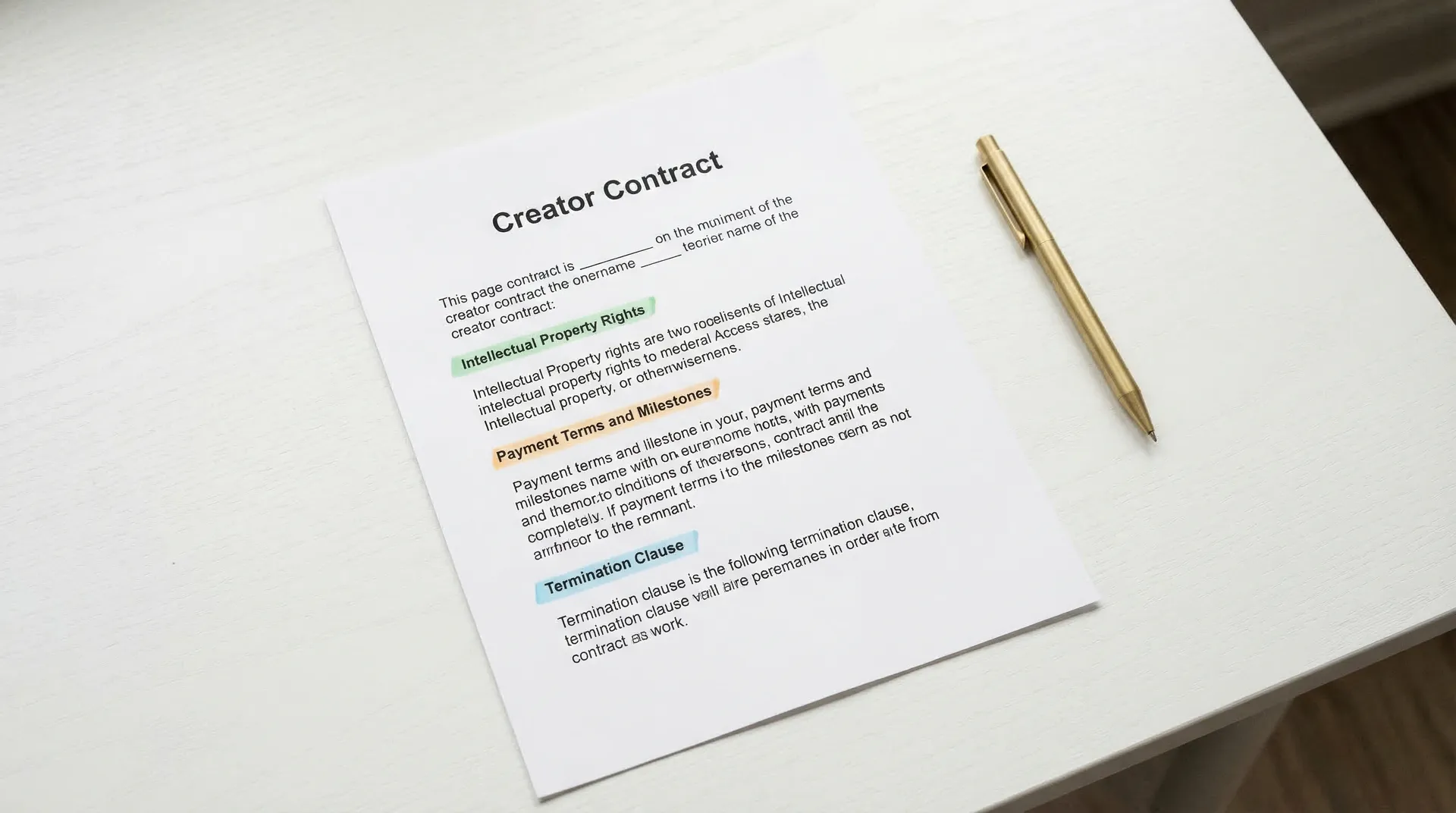
Kill fees: what you keep when brands cancel last minute
You've written the script. Done the product research. Maybe bought props or driven somewhere. The brand emails: "We're pausing this project."
Without a kill fee clause, you get nothing for that time.
A kill fee is the percentage of the total project fee you keep when a brand cancels after work has already started. Here's the tiered structure I use:
| Project Stage | Kill Fee |
|---|---|
| Before filming starts | 25% |
| After filming, before delivery | 50% |
| After first delivery | 75% |
| After first approved delivery | 100% |
The logic is straightforward: the further along the project, the more of your time and resources have already been spent. Their change of direction is their business decision — you shouldn't absorb the cost.
Some brands push back. Hold the line. The ones who argue hardest about kill fees are often the ones most likely to cancel. That's useful information.
State the kill fee in dollar amounts, not just percentages. "25% of $600 = $150, due within 3 business days of cancellation" is harder to argue with than a percentage floating in a clause nobody reads.
Revision limits: your time isn't free
Unlimited revisions isn't a feature. It's how some brands extract an extra $500 of work for free.
I've heard of creators doing 9, 10, even 12 revision rounds on a single video. Each one is 30–90 minutes of editing. The effective hourly rate on those jobs is embarrassing.
Your contract needs a hard cap. I include:
"This agreement includes 2 rounds of revisions. Additional rounds are billed at $75 per round."
Two rounds handles 90% of legitimate feedback. First round covers things you couldn't have anticipated from the brief. Second round fine-tunes. If a brand can't land approval in two rounds, the problem isn't your work — it's their internal process. That's not yours to absorb.
The revision clause should also define what "revision" actually means. Swapping out a text overlay: revision. Reshooting the entire concept because someone in marketing changed their mind: new project, new invoice.
Being specific here prevents scope creep from being framed as "just a small change."
Usage rights: licensing your content properly
Every UGC creator contract should define exactly what rights the brand is buying. "We can use it however we want" is not a usage rights clause — it's an IP handover.
The three things to nail down:
Duration — 6 months, 12 months, or perpetual? Perpetual rights cost more, and they should. I typically charge 30–40% of the base video fee on top for perpetual rights. If you're unclear on how to price this, the full framework is in my UGC usage rights and licensing fees guide.
Platforms — Organic social only? Paid ads? Both? Running your video as a TikTok or Facebook ad for 12 months has a completely different commercial value than a single organic Instagram post. The contract should list specific platforms, not just say "digital."
Exclusivity — Can they stop you from working with competitors? That's worth a significant premium and should have a time limit (usually 3–6 months maximum) with a specific category definition. "Competing skincare brands in the US" is enforceable. "Anyone who sells products" is not.
The UGC creator salary and rates guide for 2026 has benchmarks for base rates — build on those when you're calculating what to add for licensing. And if you're just figuring out base pricing before you layer on usage, this breakdown of beginner UGC rates is a good foundation.
Under US copyright law, you own the content you create the moment it's fixed in a tangible form — no registration required. A usage rights clause in your contract formalizes what you're licensing, not what you're giving away.
What to do when they still don't pay
A solid contract reduces the risk. It doesn't eliminate it.
If a brand uses your content without paying, your options depend on the amount:
Under $500: Small claims court in most US states was designed for exactly this. No lawyer needed. Filing fees typically run $30–75. Many brands will pay the invoice the moment they receive a court summons — they'd rather settle than send a lawyer.
Over $500: A formal cease and desist letter from a lawyer gets attention fast. Template-based letters from services like LegalZoom or a local IP attorney typically run $100–300. Most brands would rather pay a $600 invoice than risk copyright infringement litigation.
In all cases: Send invoices through a platform that tracks opens — PayPal, Bonsai, HoneyBook. Screenshot every email, DM, and comment where the project terms were discussed. That paper trail isn't paranoia. It's your case.
One final thing: send the contract before you film. Not during. Not after you've already delivered the first cut and are hoping they'll sign. Before a single camera turns on.
Knowing what to include in your contract matters, but so does knowing how to hold your price when brands try to negotiate it down. The brand deal negotiation scripts here cover exactly what to say when they push back on your terms.
The FTC also has clear guidance on creator agreements that affects disclosure obligations — worth reading alongside your contract setup, especially for paid ad content.
Frequently Asked Questions
What should be in a UGC creator contract?
How do I get a brand to sign my contract instead of theirs?
What is a kill fee in a UGC contract?
How many revisions should I include in my UGC contract?
Can I use my own UGC contract instead of signing the brand's?
What happens if a brand uses my UGC content without paying?
Related reading
- UGC creator salary & rates: what to charge in 2026
- How much to charge for UGC: beginner rates breakdown
- UGC usage rights: how to price licensing fees
- How to negotiate brand deals: scripts and tactics that work
- UGC creator retainer packages: how to price monthly deals
- How to build a UGC rate card that wins brand deals