UGC hooks that stop the scroll and win campaigns
Learn which UGC hooks stop the scroll and land brand campaigns. Proven opening lines by product category plus how to match hook style to brief tone.

The hook is the only thing that matters in the first 3 seconds.
Not an exaggeration. Meta's own research found that creative quality drives over 56% of a campaign's return on ad spend — and for video, that creative quality lives or dies in the opening moment. Brands aren't buying your smile or your setup or your cute transition. They're buying your ability to stop someone mid-scroll before they even register what they're watching.
I've reviewed hundreds of UGC briefs and talked to dozens of brand managers while building Crelio. The number one reason creators get rejected after a test batch isn't bad lighting, weak CTA, or mediocre acting. It's a limp hook. Every time.
So here's what I wish someone had given me early on: a real breakdown of UGC hooks that actually work, organized by type and product category, with clear guidance on matching your hook style to what the brand actually wants from the brief.
What makes a UGC hook work
A hook does one of two things. It creates curiosity — the viewer thinks "wait, what?" — or it creates recognition — they think "that's literally me." Everything else is decoration.
Most creators write intros, not hooks. "Hi, I'm Sarah and today I want to share something I've been loving." That's a death sentence. Nobody scrolling TikTok at 11pm asked for an intro. TikTok for Business data confirms that videos capturing attention in the first two seconds see significantly higher completion rates — the scroll decision happens instantly.
Strong hooks are specific. "I stopped washing my hair for 30 days" beats "I tried this hair product" every single time. Specificity feels believable. It triggers that "wait, is that real?" reflex that keeps someone watching.
Keep them short. Under 5 seconds for TikTok and Meta ads — that's one punchy sentence, two at most. You're not explaining anything yet. You're making a promise.
The 5 core UGC hook types
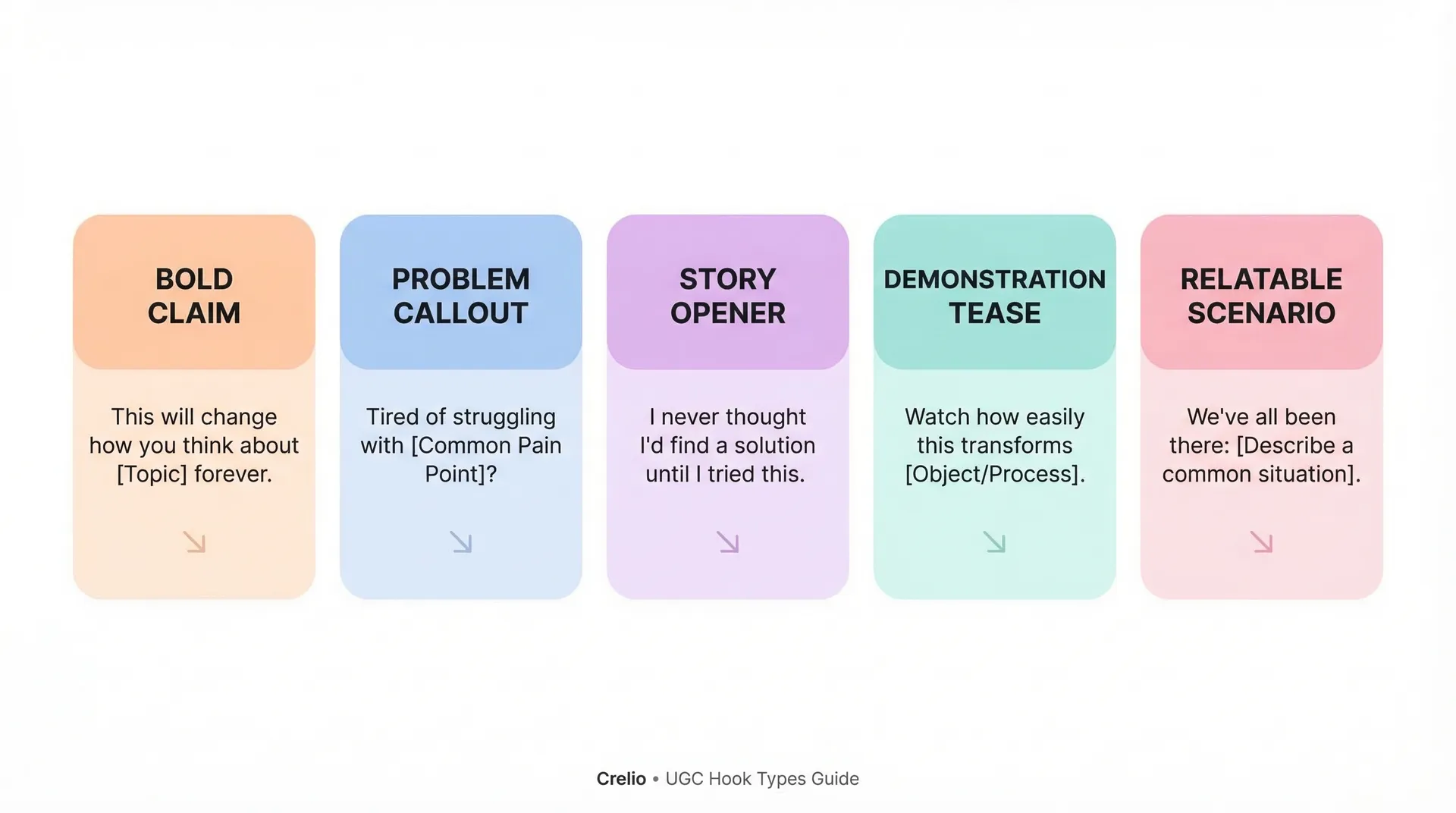
Every effective UGC hook falls into one of these categories. Learn them all, because the right type changes depending on the brief.
1. The Bold Claim Make a specific, almost unbelievable statement. The viewer's instinct is to verify it — so they keep watching.
- "This $18 serum made my skin look 10 years younger in three weeks."
- "I tested every protein powder on the market. This one won."
2. The Problem Callout Name a pain point so precisely that the right viewer feels seen. Works especially well for beauty, wellness, and productivity products.
- "If your concealer is creasing by noon, you need to see this."
- "I couldn't fall asleep without my phone. Then I tried this."
3. The Story Opener Start mid-story with no setup. Drop the viewer straight into tension or conflict.
- "Three weeks ago, I almost threw this in the trash."
- "My dermatologist told me to stop using it. She was wrong."
4. The Demonstration Tease Open with visual proof before you explain what you're showing. Let the result come first.
- "Watch what this does to my dry skin in 60 seconds."
- "This is what happened when I used it every day for two weeks."
5. The Relatable Scenario Paint a situation the target customer has definitely been in — with zero product mention. Just life.
- "POV: You're standing in the supplement aisle for the fifth time this month and you still don't know what to buy."
- "Me at 2am trying to remember if I even took my skincare off."
Hooks by product category
Different categories trigger different emotional responses. Here's what I've seen work consistently across the categories that generate the most UGC campaigns:
Beauty & skincare
Skincare audiences are skeptical by default. They've been burned by too many products that promised glowing skin and delivered nothing. Your hook needs a specific claim or a very precise pain point — vague beauty language gets ignored instantly.
- "I have hormonal acne. This is the only thing that has actually helped."
- "Everyone talks about vitamin C but nobody tells you which one doesn't oxidize."
- "My skin was exactly the same for three years. Then I added one step."
- "I finally found a foundation that doesn't look cakey on dry skin."
If you can name the skin concern specifically (redness, closed comedones, hyperpigmentation), do it. That precision is what makes a skeptic stop.
Health & wellness
This category runs on two fuels: FOMO around a health trend, and frustration with things that haven't worked. The "authority figure" hook performs extremely well here — borrowing credibility from a doctor, nutritionist, or therapist.
- "I've spent over $2,000 on supplements. These three are the only ones I kept buying."
- "The thing nobody tells you about taking magnesium before bed."
- "A functional doctor finally told me the truth about my fatigue."
- "I've been doing this wrong for 5 years."
Tech & apps
Tech hooks need contrast: life before versus life after. Or make the problem feel so universal that the viewer can't help but nod.
- "I had 14 browser tabs open every single day. This fixed it in one afternoon."
- "I was spending 3 hours a week writing emails. Now it's 20 minutes."
- "The reason your phone battery dies by 3pm isn't what you think."
- "I switched note-taking apps 8 times in 2 years. I'm not switching again."
Specific time savings and number comparisons hit hard. Quantify the before state in the hook itself whenever you can.
Food & beverage
Food content lives on sensory detail and social context. Comparison hooks — "tastes like X but with Y benefit" — set a concrete expectation that drives curiosity.
- "I made this at a dinner party and three people asked for the recipe before dessert."
- "This tastes exactly like a Reese's and it has 4 grams of sugar."
- "I've been eating the same boring lunch for two years. Not anymore."
- "The meal prep trick that saved my Sunday afternoons."
Fashion & accessories
Fashion hooks work best when they solve an outfit anxiety or make the viewer feel like an insider who just learned something others don't know.
- "The outfit formula I use when I genuinely have nothing to wear."
- "I wore this to three different events and nobody knew it was the same dress."
- "My stylist told me to stop buying this and buy this instead."
- "This is the only white sneaker that doesn't look grey after one wear."
Matching your hook to the brief tone
Here's where creators lose campaigns they should have won. They pick a hook style they're personally comfortable with instead of the one that fits the brief. Reading the brief properly is step one — but knowing what to do with the tone signal is what separates the creators getting consistent work from the ones sending proposal after proposal with no reply.
Brief says "authentic" or "organic-feeling" → Story Opener or Relatable Scenario. The brand wants it to feel like a real person's genuine moment, not a polished ad. Lead with life, not a product claim.
Brief mentions "performance" or "conversion" → Bold Claim or Problem Callout. Brands optimizing for conversion want hooks that filter in the right viewer fast. Efficiency over warmth.
Brief asks for "educational" content → Demonstration Tease. "Watch what happens when…" or "Here's what this actually does to your skin" is your default opening move.
Targeting a cold audience → Relatable Scenario or Problem Callout. Cold audiences don't know the product exists. You need to meet them in their reality first, introduce the solution second.
Retargeting ads → you have more latitude. Bold Claim hooks work well because the audience already has some brand awareness. You can go harder on the product.
One more rule: if the brief doesn't specify tone, look at the brand's existing ads. That's their revealed preference. According to Nielsen research on digital advertising, creative consistency across touchpoints increases brand recall significantly — meaning brands usually have a pattern they're sticking to. Match that energy rather than going rogue.
Hooks that consistently don't work anymore
"You guys, I have to share something." Overused. Everyone's seen it. Nobody stops.
"Okay, so I wasn't planning to film this but..." This used to feel candid. Now it signals "ad" to anyone who's been online for more than six months.
"This might not work for everyone but..." You just told the viewer the product might not work. You've hedged your own hook. Don't do this.
The slow build. Spending the first 5 seconds establishing context before you even deliver the hook. No. Hook first, context second, always — without exception.
Once you've nailed your opening line, the rest of the video needs to deliver on the promise you made. That's what a solid UGC script is for — the hook buys you 3 seconds, the script earns the rest. And if you're still in the process of landing campaigns at all, the full picture is in how to land UGC campaigns as a creator in 2026.
The creators winning the most brand work right now aren't the ones with the best cameras. They're the ones who've built a library of hook formulas and know how to deploy them. Start building yours.
Frequently Asked Questions
What is a UGC hook?
How long should a UGC hook be?
What are the best UGC hook types for ads?
Should I use the same hook style for every product?
How do I know which hook to use from a brief?
Can hook formulas transfer between products?
Related reading
- How to land UGC campaigns as a creator in 2026
- How to read a UGC campaign brief (and what brands want)
- How to write a UGC script that gets approved fast
- How to pitch brands for UGC: cold outreach templates
- UGC creator rates: what to charge for videos and photos
- UGC contract template: what to include before you film