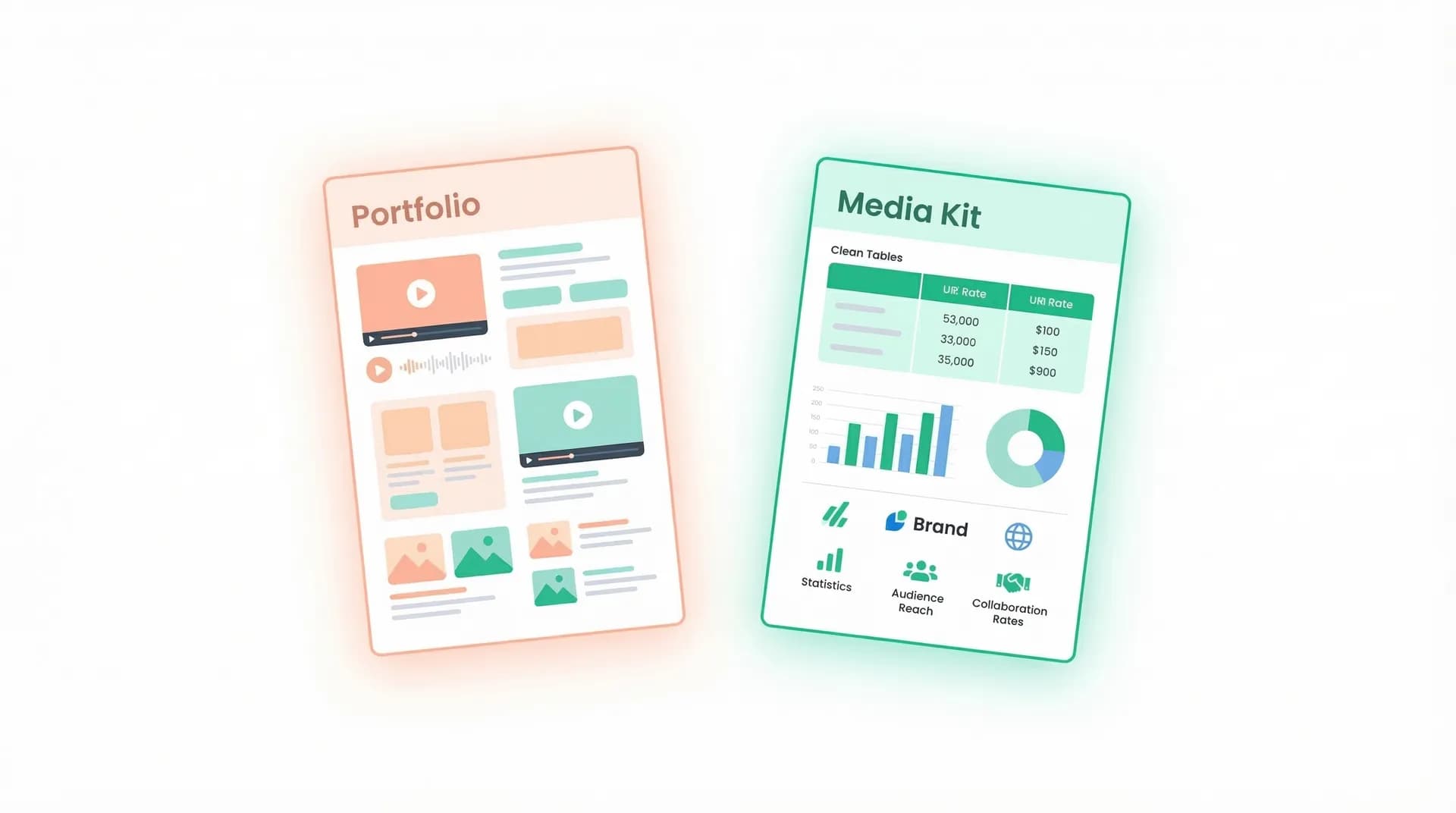
UGC media kit vs portfolio: what's the difference?
A UGC media kit and a UGC portfolio are not the same thing. Learn what each one does, what to put in each, when to send which, and how to combine them.

A brand DM landed in my inbox last year — forwarded from a creator asking why she never heard back. She'd prepared a gorgeous Canva deck full of her best videos. Stunning product shots, clean edits, solid hook sequences. Twelve pages of real skill.
The brand had asked for a media kit. She sent a portfolio.
Not the same thing. Not even close.
She didn't get a response because the brand manager couldn't find her rates, didn't know her turnaround time, had no idea which platforms she creates for, and couldn't quickly see whether she'd worked with brands before. The portfolio showed she was talented. The UGC media kit would have told them whether they could actually hire her.
This confusion costs creators deals every week. Let me fix it.
What a UGC media kit actually is
A media kit is a sales document. That's it.
It's not a showreel. It's not a creative portfolio. It's the answer to every logistical question a brand manager has before they decide to work with you — formatted so they can skim it in 30 seconds and, if they want, forward it to their director without needing to explain who you are.
According to HubSpot's breakdown of media kit best practices, a media kit exists to communicate your value proposition in a way that removes friction from a purchasing decision. For UGC creators, that means:
- Who you are — one sentence, not your life story
- Your content niches — beauty, tech, food, fitness, home, etc.
- What you deliver — video formats, photo packages, hooks, ad creatives, raw footage
- Your pricing — at minimum a "starting at $X" figure so bad-fit brands self-filter
- Past brand work — logos or names of brands you've collaborated with
- Social proof — a single stat or testimonial if you have one ("3.2M+ views generated for client ad creatives")
- Contact and booking info — Calendly link, email, whatever you actually check
One to two pages. Clean, fast to skim, easy to forward. That's a UGC media kit.
What it's not: a video gallery, a link to your best TikToks, or a 20-slide Canva deck showing every style you've ever attempted. Those belong in your portfolio.
What your UGC portfolio is for
Your portfolio is a proof document, not a pitch document.
Its job is to show the quality of your content — your editing style, your ability to sell through video, your range of formats. When a brand lands on your UGC portfolio, they should be able to form an opinion about your creative ability within 60 seconds.
A strong portfolio includes:
- 5–10 of your best content pieces, not everything you've made
- Format variety — unboxing, testimonial, lifestyle, product close-up, hook tests
- Focused niche work if you specialize, or range across categories if you're a generalist
- Spec work or mockups if you're starting out — these work, and brands don't always ask whether a piece was paid
The portfolio answers one question: Can this creator do the work? Nothing else.
It doesn't need your rates. It doesn't need your turnaround time. It doesn't need a logo grid of past clients. That's what the media kit is for.
The real difference: one sells, one proves
Here's the cleanest way to say it.
Your portfolio answers: Can they do the work?
Your UGC media kit answers: Should we work with them?
Two different questions. Two different people asking them. Two different moments in the decision-making process.
A creative director reviewing content for a campaign wants to see your portfolio. They're evaluating your aesthetic and your execution. A brand manager calculating whether you fit the budget needs your media kit. They're making a business decision.
The mistake most creators make is building one document and trying to make it do both jobs. The portfolio ends up cluttered with rate cards. The media kit turns into a 15-slide showreel. Neither does either job well.
When to send which one
Send your UGC media kit when:
- A brand or agency DMs asking about collaboration
- You're doing cold outreach — attach it to your pitch email
- Someone asks "what are your rates?" — your media kit answers that question in context
- You're applying to a creator database, marketplace, or talent roster
Send your portfolio when:
- A brand asks to see your work before deciding
- You're applying to a specific campaign brief
- You're in a second conversation where interest is already established
- Someone asks "can you send examples?"
When a brand says "send me your info" and you're not sure which they want, lead with the media kit. It's faster to process and answers the questions that gate the decision. You can always follow up with portfolio samples if they want to go deeper.
What actually goes inside a solid UGC media kit
I've reviewed a lot of these. Here's what gets responses vs what gets ignored.
A one-sentence opener. "I create conversion-focused short-form videos for DTC brands in the wellness and beauty space." That's enough. Brands know immediately whether you're relevant.
Your content niches. Be specific. "Beauty, skincare, supplements, clean living" is more useful than "lifestyle content." Brands want creators who understand their product category.
What you deliver. Concrete deliverables: 30-second vertical video, 3 revision rounds, 5-business-day turnaround, raw files included. Specifics build confidence. Vague terms like "custom content" raise questions.
Your rates. This is where creators get cagey. Don't be. You don't need to list every possible price — a starting package rate or a price range is enough. Brands that can't afford you will disqualify themselves. That saves both of you time. (For how to frame this without underselling yourself, see the UGC rates display guide.)
Brand social proof. One stat or one client quote. "Generated 4.1M impressions across three campaign videos" beats a generic claim every time. If you're early and don't have this yet, a strong testimonial from anyone — even a spec client — works.
One or two content thumbnails. Just a taste. Not a full gallery — that goes in your portfolio. Two strong stills show your aesthetic without turning the media kit into a showreel.
Contact info. A direct booking link if you have one. At minimum, an email and the best way to reach you. Make it impossible for them to lose track of how to hire you.
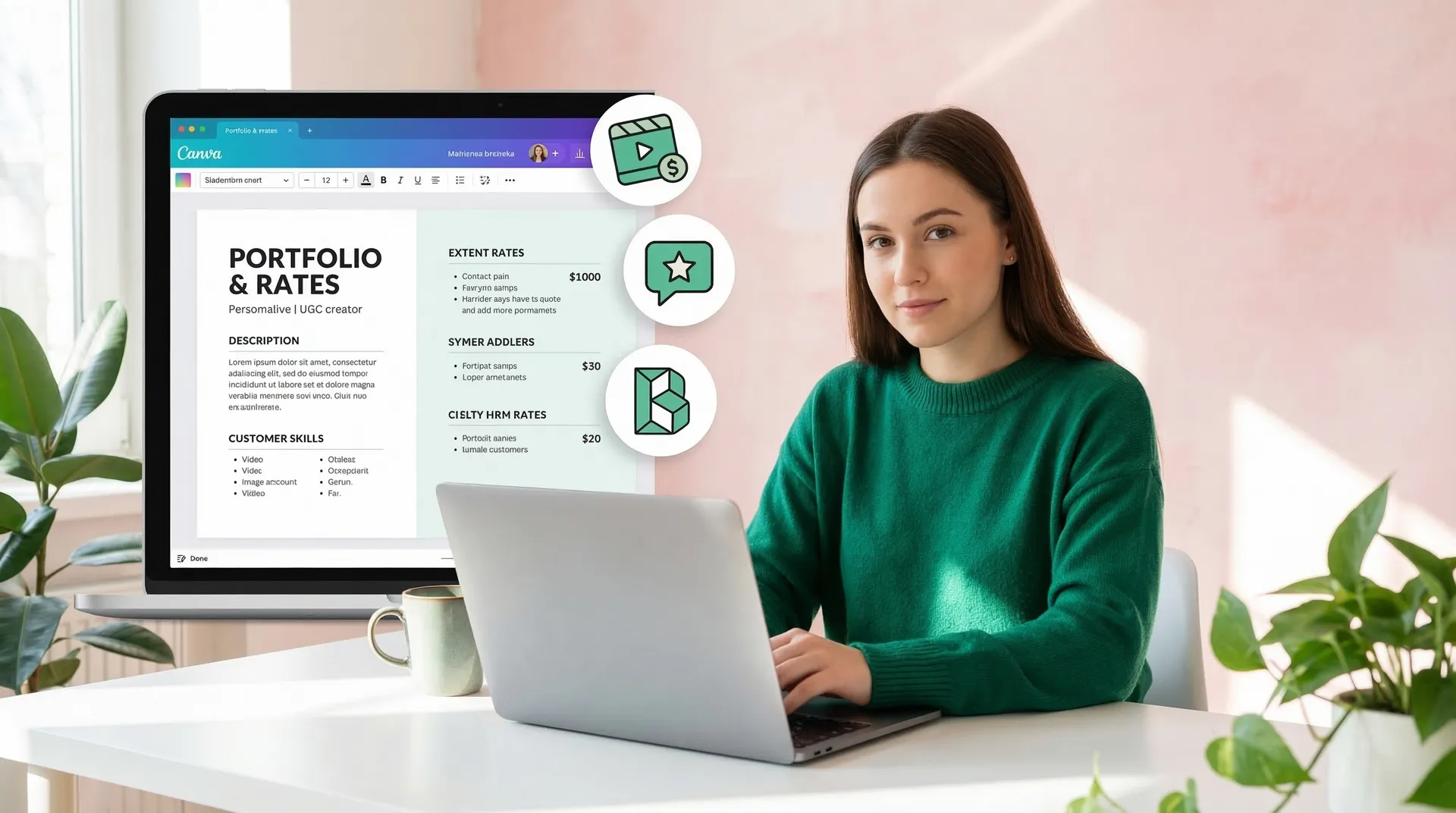
Keep the design simple. One font, two brand colors, a clean header. Canva's media kit templates are a reasonable starting point. The same design discipline that makes a portfolio clean applies here — see how to build a UGC portfolio in Canva for a layout approach that translates well.
Do you need both? And how to combine them
Yes, you need both. But you don't have to maintain them as two separate documents.
The smarter move for most creators is a pitch deck hybrid: a PDF that leads with 1–2 pages of media kit information, then follows with a 3–5 piece content gallery. One document, both questions answered, nothing for the brand to chase.
This works well for cold outreach especially. You attach one clean PDF, the brand sees your rates and services upfront, then scrolls to see your actual work. No back-and-forth. No "can you send examples?" follow-up.
For your website, keep them separate. Put your full portfolio on your creator site — see the best UGC portfolio website options for where to host it. Keep your media kit as a downloadable PDF you update every 3–6 months as your rates change and your brand roster grows.
If you're starting from zero and don't have brand deals yet, how to make a UGC portfolio with no experience shows how to build credible content samples before your first paid campaign. Do that first, then build the media kit around it.
According to Influencer Marketing Hub's 2025 creator economy data, brands are increasingly working with micro and nano UGC creators who position themselves professionally. A polished media kit is one of the fastest signals that you treat this like a business.
The thing to do this week
Look at whatever document you currently send brands.
If it's all content samples and no business info — you have a portfolio. Build a two-page media kit this week.
If it's heavy on rates and logistics but thin on actual content proof — add a gallery section at the back.
If you have neither? Start with the media kit. It takes an afternoon to build in Canva, and it's the thing that gets you in the room. Your portfolio can develop alongside your first few deals.
Brands move fast. The creator who sends the right document at the right moment — the one that answers the exact question being asked — is the one who gets the reply.
Frequently Asked Questions
What should a UGC media kit include?
Is a UGC media kit the same as a portfolio?
Do UGC creators need a media kit?
How long should a UGC media kit be?
Can I combine my UGC media kit and portfolio into one document?
When should I send my media kit vs my portfolio?
Related reading
- How to build a UGC portfolio that wins brand deals
- UGC portfolio template: the exact sections brands want
- How to pitch brands as a UGC creator: email templates
- How to display your UGC rates inside your portfolio
- Best UGC portfolio website options (free & paid)
- How to make a UGC portfolio with no experience (2026)