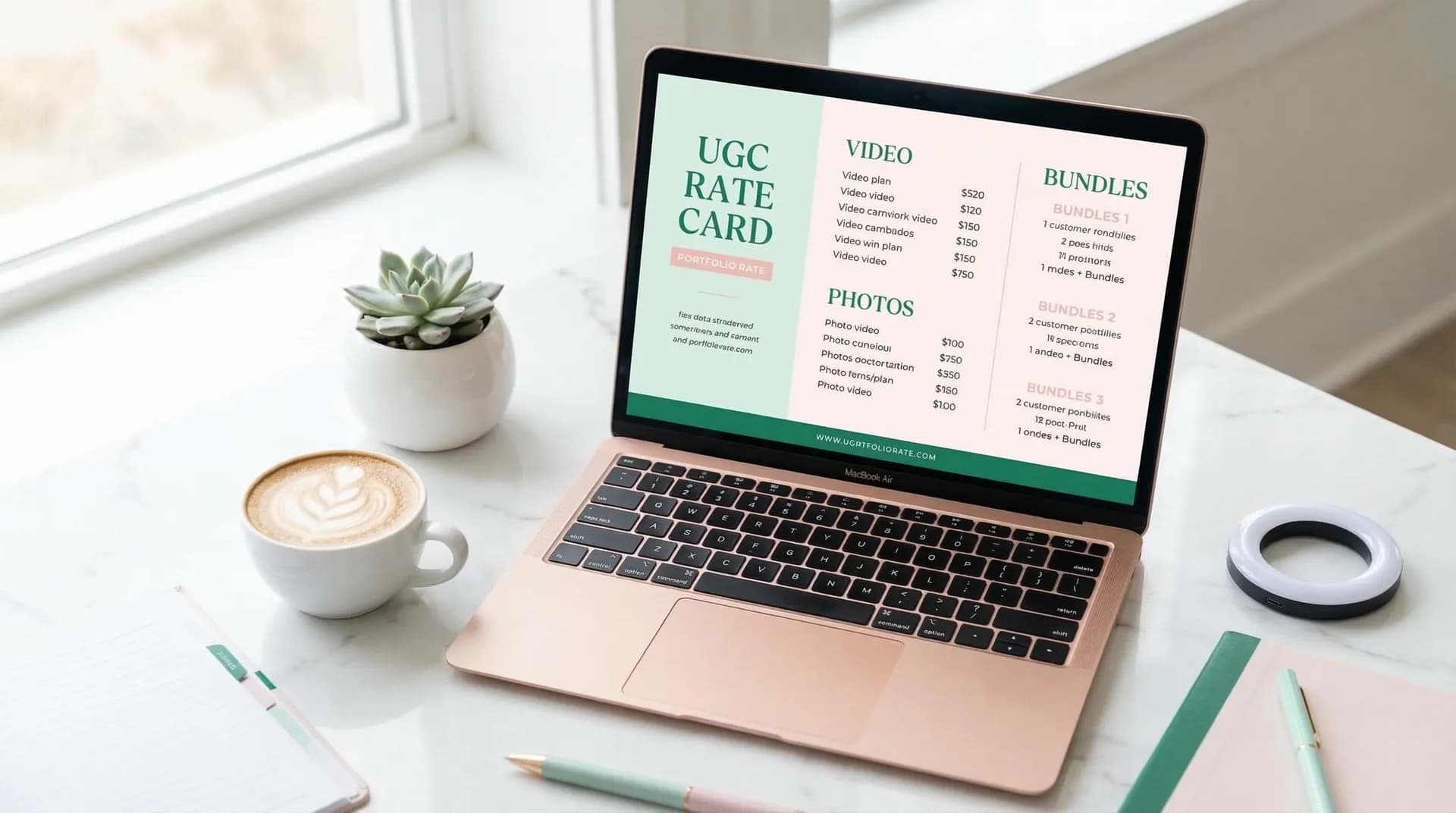
How to display your UGC rates inside your portfolio
Learn how to display UGC portfolio rates the right way—rate card placement, per-deliverable pricing breakdowns, and framing tips to stop lowball offers from brands.

I got a DM from a brand last year asking for my rate. I'd spent weeks building a portfolio I was actually proud of — five solid UGC videos, a strong niche, a clean layout. No pricing page. "I'll discuss rates on a call," I thought.
They came back with $45 for a 30-second video.
That was my fault, not theirs. When you don't show your UGC portfolio rates, brands fill in the blank themselves — usually with the lowest number they think they can get away with. Displaying your pricing clearly isn't just transparency. It's about controlling the frame before a single word gets exchanged.
Here's how to do it in a way that attracts the right brands and filters out everyone else.
Should you show your UGC portfolio rates publicly?
The creator community is split on this. Half say never post public pricing because "every deal is different." The other half swear by full transparency.
I've tried both. Public rates win.
The brands that ghost you when they see your prices weren't going to pay them anyway. They were going to waste two hours of your time on a discovery call, lowball you at the end, and vanish. Filtering them out upfront is a feature, not a bug.
That said — how you display your UGC rates matters as much as whether you display them. A raw price list with zero context is just as likely to get you lowballed as showing nothing at all.
Where exactly to put pricing in your portfolio
Most creators either dump their pricing in a separate Google Doc or hide it behind a "contact me" button. Both are mistakes.
Your rates should live inside the portfolio itself — as a dedicated section or page, not linked from a footer, not a separate attachment. Right there, alongside your work.
If you're building on Notion, a Canva deck, or a dedicated platform (we've reviewed the best UGC portfolio website options here), you have full layout control. Put the rates section after your work samples and before your contact info. That sequence matters.
Work → Niche/about → Rates → Contact.
First you earn credibility with your content. Then you set expectations with pricing. Never lead with rates — you haven't made the case for them yet.
How to structure per-deliverable pricing
Lump-sum "packages" confuse brands. UGC buyers have budgets broken down by deliverable type. A "$600 starter package" with three vague items doesn't map to how a performance marketing team thinks.
Break it out. The format that consistently performs:
Deliverable → Format → Rate
| Deliverable | Format | Rate |
|---|---|---|
| Short-form video | 15–30 sec, 1 revision | $150–$200 |
| Short-form video | 30–60 sec, 1 revision | $200–$300 |
| Static image | 1–3 product shots | $75–$100 |
| Video testimonial | 60 sec, scripted | $250–$350 |
| Bundle | 3x short-form, mixed formats | $450–$500 |
Those are typical beginner-to-mid-level UGC rates. If you're not yet sure where to set your floor, get clear on your numbers first — our beginner rates breakdown covers the full logic.
A few things to call out explicitly in this section:
What's included. One round of revisions, one usage window (30 days digital), raw or final — be specific. Vagueness invites scope creep.
What costs extra. Whitelisting/paid usage rights, raw file delivery, rush turnaround, exclusivity windows. A single line saying "+30% for paid usage rights" will measurably raise your average deal value over time.
What you don't do. Optional but powerful. If you only work in beauty and wellness, say so. If you don't do alcohol brands, list it. It saves everyone time and signals that you know your lane.
Real examples by experience level
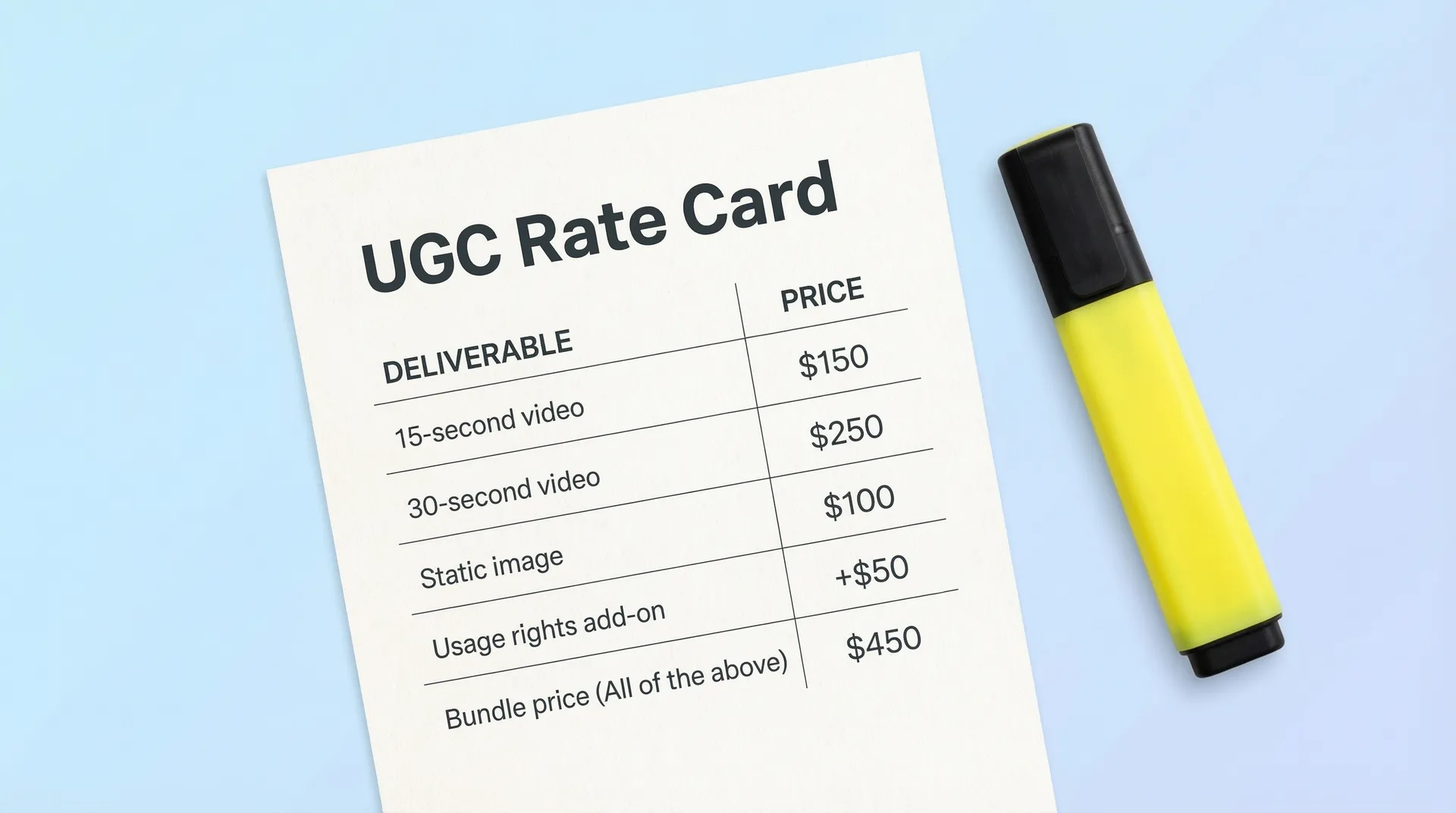
Here's how this looks in practice across three stages of a creator's career.
Beginner (0–6 months, building your sample library)
15-sec video: $75 | 30-sec video: $100 | Static image: $50 Usage rights (30 days): included | Usage rights (90 days): add $50 Bundle: 3 videos for $250
Simple. Doesn't apologize for charging anything. Even early on, presenting rates this way signals professionalism over "how much do you have in your budget?"
Mid-level (6–18 months, clear niche, repeat clients)
30-sec video (1 revision): $200 | 60-sec video (1 revision): $300 Static lifestyle content (3 images): $150 Paid usage rights, 60 days: +$100 | Raw files: +$75 Rush delivery under 48 hours: +30%
This structure shows you understand licensing — which immediately positions you as a creator brands want to work with again. That's exactly the kind of credibility that makes your UGC portfolio do the heavy lifting before you even reply to an inquiry.
Experienced (18+ months, proven results, anchor brands)
Retainer: 4 videos/month — $1,200/month Standalone video (up to 60 sec): $400–$600 Usage rights — 90 days digital: $250 | 12 months all-platform: $600 | Exclusive: custom quote Brand strategy consultation: $150/hr
Notice the shift here. Experienced creators move away from à la carte and toward retainers. It's not just about money — it's a positioning statement. You're no longer selling content delivery. You're selling a content partnership. That distinction changes every conversation.
For the full structure of a standalone rate card document, our UGC rate card guide covers the exact layout brands expect to see.
How to frame your rates to stop lowball offers
The number alone doesn't do the work. The framing around it does.
Three things that consistently reduce lowball offers after publishing your UGC pricing:
Anchor high first. If you list "videos from $100," a brand reads "$100." List "video packages starting at $400, individual deliverables from $200" and the anchor shifts. Show the higher tier first — always.
Attach results to your rates. Right next to your pricing section, include a proof point. One line: "These videos drove a 3.2% conversion rate on Meta for [Brand]." Social proof sitting beside pricing is a completely different psychological object than a price list sitting alone.
Remove the word "negotiable." The moment you write that, you've told every brand to open below your number. If you want flexibility for bigger deals, write instead: "Volume pricing available for monthly retainers." That signals you reward commitment — not that you'll fold on a $150 video.
According to a Nosto study on consumer trust in UGC, 79% of people say UGC highly impacts their purchasing decisions. Brands know this. You should price like you know it too.
The thing most creators leave out entirely
Usage rights.
I've reviewed hundreds of UGC portfolios for research. Most show deliverable pricing. Almost none clearly price usage rights as a separate, visible line item.
This is where professional-level UGC rates live. A brand running your video as a paid ad for six months is extracting real, compounding value from your work — that's worth real money beyond a creation fee. Industry norms suggest usage licensing adds 20–100% on top of base creation fees depending on duration, exclusivity, and platform scope. The FTC's influencer guidelines and standard commercial licensing frameworks both recognize usage as a separate transactional layer.
Make it a visible, expected line item. You'll attract brands who understand how the business works — and filter out the ones who don't.
For a deeper look at which sections brands actually look for when reviewing a portfolio — including how pricing fits with the rest of your presentation — check out the UGC portfolio template guide.
One last thing. Your rates aren't permanent. Review them every three to four months. If you're booking every inquiry without pushback, your rates are too low. Aim for a 60–70% close rate — some friction is normal and healthy. The brands that push back hardest on pricing are rarely the ones you want for long-term work anyway.
Frequently Asked Questions
Should I show my UGC rates publicly in my portfolio?
What are typical UGC rates for a 30-second video?
Should I include usage rights pricing in my UGC portfolio?
What's the difference between a rate card and a UGC portfolio?
How do I avoid lowball offers after showing my rates?
How often should I update the rates in my UGC portfolio?
Related reading
- How to build a UGC portfolio that wins brand deals
- UGC portfolio template: the exact sections brands want
- 15 UGC portfolio examples that actually land brand deals
- How to build a UGC rate card that wins brand deals
- How much to charge for UGC: beginner rates breakdown
- Best UGC portfolio website options (free & paid)