UGC portfolio template: the exact sections brands want
A fill-in-the-blank UGC portfolio template with every section brands look for — bio, niche, deliverables, past work, and rates. Stop losing deals to missing info.

I've spoken to brand managers at companies spending $30k–$100k/month on UGC. When I ask why they pass on creators, the answer is almost never "the content wasn't good enough." It's almost always "I couldn't figure out what they do" or "their rates weren't anywhere in the portfolio."
Brands don't have time to chase you for information. If your ugc portfolio template doesn't answer their questions upfront, they'll find a creator who does.
So here's exactly what to include — section by section — and what to actually write in each one.
The UGC portfolio template, section by section
Think of your portfolio as a sales page, not a mood board. Every section exists to answer one of the brand's questions before they have to ask it. Miss a section, create friction. Create friction, lose the deal.
Here are the seven sections that matter, in the order brands expect them.
Section 1: Your creator bio (2–4 sentences max)
Brands aren't looking for your life story. They want to know who you are, what type of content you make, and whether you're the right fit — in about ten seconds.
Template:
"I'm [Name], a UGC creator specializing in [niche/category] content for [type of brand — beauty, wellness, tech, etc.]. I've worked with [X number] brands over the past [timeframe], creating [content types] that feel authentic and convert. Based in [City/Country]."
Keep it tight. One paragraph. No backstory about how you "found your passion" — that's for your Instagram bio, not your brand pitch.
If you're just starting out and haven't worked with brands yet, say you create content for "personal projects and spec work across [your niche]." Don't fabricate brand names. Brands verify references more than you think.
Section 2: Your niche and content categories
Generalists get ignored. Brands want to know: do you understand my customer?
Template:
Niche: [Primary niche — e.g., skincare, home organization, fitness supplements] Secondary niches: [1–2 adjacent categories you've created for] Platforms: [Where your content is built for — TikTok, Instagram Reels, YouTube Shorts, etc.] Content style: [e.g., aesthetic/lifestyle, educational how-to, unboxing/review, talking head, GRWM]
Don't just say "lifestyle." That means nothing. "Budget skincare for women 25–35" means something.
This is also where you build trust before they even see your work. When a brand is looking for a creator to sell their face serum, and your niche section says "skincare + wellness for millennial women," you've already answered their first filter question.
Section 3: Deliverables menu
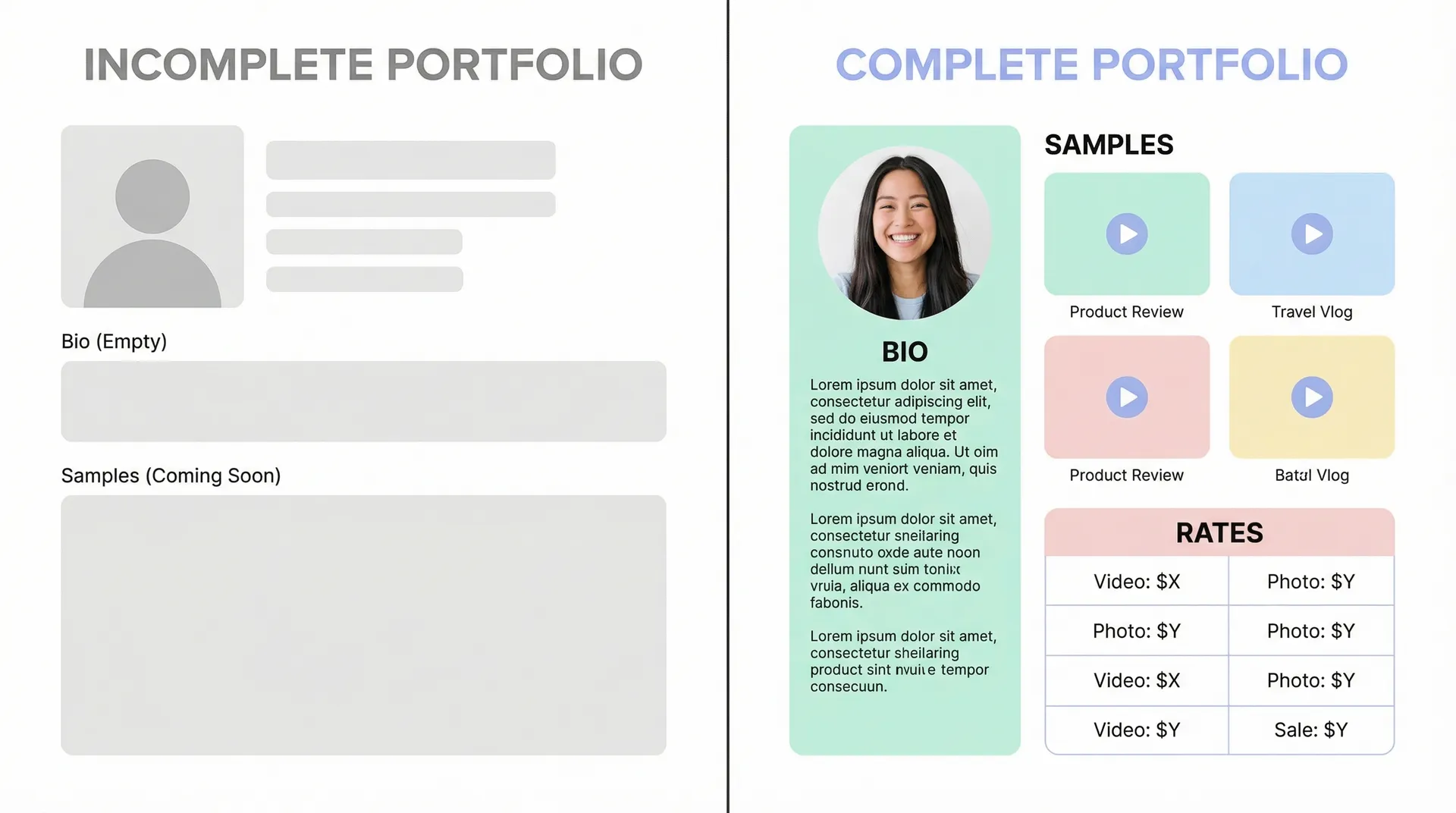
This is the section most creators skip, and it's the one that closes deals. Brands need to know exactly what they can order from you — like a menu.
Template:
| Deliverable | Format | Length | Includes |
|---|---|---|---|
| UGC Video Ad | Vertical MP4 | 15–30s | Hook, product showcase, CTA |
| UGC Video Ad | Vertical MP4 | 45–60s | Testimonial-style, problem/solution |
| Photo Pack | JPG/PNG | 3–5 images | Lifestyle, product-only, flat-lay |
| B-roll Package | MP4 clips | 10–15 clips | Raw clips for brand editing |
| Static Ad Creative | JPG | Single image | Brand-approved overlay text |
Be specific about file formats, aspect ratios, and what's included. "Videos" is not a deliverable. "15-second vertical TikTok-ready video with hook, product demo, and spoken CTA, delivered as .mp4 in 1080x1920" is a deliverable.
If you offer revisions, state how many. Brands budget around revision rounds.
Section 4: Past work / content samples
This is the section that actually makes or breaks the deal. Everything else builds the case; this is the proof.
What to include:
- 3–5 video samples minimum (10+ is better if you have them)
- Each sample should be labeled with the product category, not the brand name
- Mix formats: a 15s hook-driven ad, a 30s testimonial, a lifestyle b-roll edit
- If you have before/after performance data from a brand, include it (with permission)
Template for labeling each sample:
"[Skincare] — 30s hook-driven testimonial ad. Created for a DTC serum brand. Delivered in vertical 9:16."
Don't just dump a Google Drive link with 40 unlabeled clips. Brands aren't going to sort through your raw footage. Curate it. Label it. Make it frictionless to watch.
This is where most creators go wrong — they have solid work, but it's buried in a chaotic folder. If you want to see what a clean sample section actually looks like in practice, check out our 15 UGC portfolio examples that actually land brand deals.
Never include a brand's content in your portfolio without explicit permission. Some brand contracts have confidentiality clauses. When in doubt, ask — or swap in a spec video you created in the same style.
Section 5: Past brand collaborators + social proof
Even one recognizable logo builds credibility fast. If you've worked with brands — list them. If a brand gave you positive feedback — quote it.
Template:
Past collaborators: [Brand A], [Brand B], [Brand C]
"[Name] delivered above our expectations. The hook she wrote outperformed our internal creative by 2x on CTR." — Marketing Manager, [Brand Name]
No past collaborations yet? Skip this section for now — a blank section is worse than a missing one. Come back to it after your first three deals. And if you want to know how to get those first deals, read how to land your first UGC campaign as a creator before you send your portfolio anywhere.
Section 6: Your stats (optional but powerful)
You don't need a massive following to include stats. You need relevant numbers.
What to include:
- Total videos delivered to date
- Average turnaround time
- Any performance data brands have shared (CTR, ROAS, views on ad)
- Client retention rate if applicable ("80% of my clients book repeat packages")
What to skip: your follower count. Unless you're also offering influencer amplification, your TikTok following is irrelevant to a brand buying UGC. They're buying the content, not the distribution.
Section 7: Rates and packages
Not having a rate section is the single biggest portfolio mistake I see. Brands don't want to negotiate before they've even decided they like you. Give them a starting point.
Template:
Starter Package — $[X] 3 x 15–30s UGC videos, raw + edited, 2 revision rounds, 7-day turnaround
Growth Package — $[X] 6 x 15–60s UGC videos + 5 static images, 7-day turnaround, 2 revision rounds
Custom / Ongoing — Let's talk
If you're unsure how to price, FYPM and Passionfroot both publish creator rate data regularly. Study what creators at your experience level are charging.
Don't apologize for your rates. Don't say "starting from" unless you mean it. Quote what you'll actually charge and own it.
The most common portfolio mistakes (and what kills deals)
After seeing hundreds of creator portfolios, these are the ones that come up constantly:
- No rates section. Brands assume you're either too expensive or too inexperienced to have pricing figured out.
- Samples buried in Google Drive. Use Notion, a personal site, or a purpose-built tool. Friction kills conversions.
- Generic niche description. "Lifestyle creator" is a pass. "Sustainable home products for young families" is a yes.
- No contact CTA. Your portfolio should end with one clear action: email you, book a call, or fill a form.
The full strategic playbook for what makes a portfolio convert — not just exist — is in how to build a UGC portfolio that wins brand deals. The template above is the skeleton. That guide is how you make it perform.
Your portfolio is a living document. Update your samples every 60–90 days. Remove content that's more than 12 months old unless it's still representative of your best work. Brands can tell when a portfolio hasn't been touched since 2022.
Putting the template together
Here's the full section order at a glance:
- Creator Bio — who you are, what you make, where you're based
- Niche + Content Categories — your focus areas, platforms, content style
- Deliverables Menu — exactly what brands can buy from you, with specs
- Past Work / Samples — 5–10 labeled, curated content examples
- Brand Collaborators + Testimonials — logos and quotes if you have them
- Stats — relevant numbers only (skip follower count unless it's relevant)
- Rates + Packages — clear starting prices, no guesswork for brands
Build it in Notion, on a personal domain, or inside a platform built for creators. Whatever format you choose, keep it clean, scannable, and current. A brand manager will spend 20 seconds on it before deciding whether to reply.
Make those 20 seconds count.
Frequently Asked Questions
What should I include in a UGC portfolio template?
How long should a UGC portfolio be?
Should I include rates in my UGC portfolio?
Do I need a following to create a UGC portfolio?
What format should I use for my UGC portfolio?
How many samples should I include in my UGC portfolio?
Related reading
- How to build a UGC portfolio that wins brand deals — the full strategy behind what makes a portfolio convert, not just what to include
- 15 UGC portfolio examples that actually land brand deals — real-world examples showing exactly how the template looks when it's done right
- How to land your first UGC campaign as a creator — once your portfolio is ready, here's how to actually get it in front of brands
- UGC video production: your complete beginner's guide — making sure the samples inside your portfolio are worth showing