UGC pricing models: per video, packages, and bundles
Compare per-deliverable, bundle, and tiered UGC pricing models so you can choose the structure that maximises your revenue as a creator.

I've watched creators leave hundreds of dollars on the table — every single month — not because they priced too low, but because they chose the wrong pricing structure. They quoted per video when they should have pitched a bundle. Or locked themselves into a retainer when a one-off deal would have served them better.
UGC pricing isn't just about the number. It's about the model. Pick the wrong one and you either scare brands off or undersell yourself badly.
Here's how the three main UGC pricing models actually work — and when to use each one.
The three main UGC pricing models
Before we get into specifics, it's worth naming them clearly:
- Per-deliverable pricing — you charge a flat rate per video (or photo)
- Bundle pricing — you group deliverables at a discounted rate
- Tiered/package pricing — you offer structured tiers (basic, standard, premium) with defined deliverables at each level
Each has a different psychology, different use case, and different impact on your monthly revenue. None is universally better. The right one depends on the brand, the brief, and where you are in your creator career.
Per-deliverable pricing: simple, but it caps your ceiling
Per-video is the default most new creators land on. Quote $150 per video, brand orders three, you make $450. Clean.
The upside: it's easy to explain, easy to invoice, and brands understand it immediately. No negotiation needed on scope. You film what you quoted, you get paid, you move on.
The downside: it leaves you entirely at the brand's mercy. They can order one video this month, ghost you for two months, then come back for five. Your income is completely unpredictable. And because there's no commitment from the brand, they have zero incentive to work efficiently with you — they might sit on a brief for three weeks before you even start filming.
Per-deliverable works best for:
- First-time work with a new brand (low commitment = lower barrier to saying yes)
- One-off campaigns with a defined end date
- High-ticket niches where a single video justifies a strong rate
If you want to understand what those per-video rates should actually be, the UGC creator salary & rates: what to charge in 2026 guide has current benchmarks broken down by experience level and niche.
Bundle pricing: your fastest path to higher average deal value
Bundles are where most mid-level creators should be operating. Instead of quoting $150 per video, you offer five videos for $600 — that's $120 each, a 20% "discount." The brand feels like they're getting a deal. You get a bigger upfront commitment and a higher total invoice.
But here's the part most creators miss: bundles don't just increase order size. They change the dynamic of the relationship. When a brand commits to five videos, they're invested. They want the content to perform. They give better briefs, faster feedback, and clearer direction. The working relationship gets better automatically.
The key is structuring bundles so the "discount" is real on paper but your effective hourly rate stays flat or goes up. If you spend the same amount of time on each video regardless of quantity, a bundle should only offer value through reduced admin overhead — not reduced compensation for your creative work.
A rough framework that works:
| Bundle size | Discount |
|---|---|
| 3 videos | 5% |
| 5 videos | 10–15% |
| 10+ videos | 20% max |
Don't go beyond 20% no matter how much a brand pushes. At that point you're building a retainer relationship — which deserves its own pricing conversation. Speaking of which, UGC creator retainer packages covers exactly how to structure those ongoing monthly deals.
One thing brands love about bundles: they can plan their creative calendar. One invoice, predictable output, no back-and-forth on rates every time they need content. That convenience has real value — you're allowed to price it accordingly.
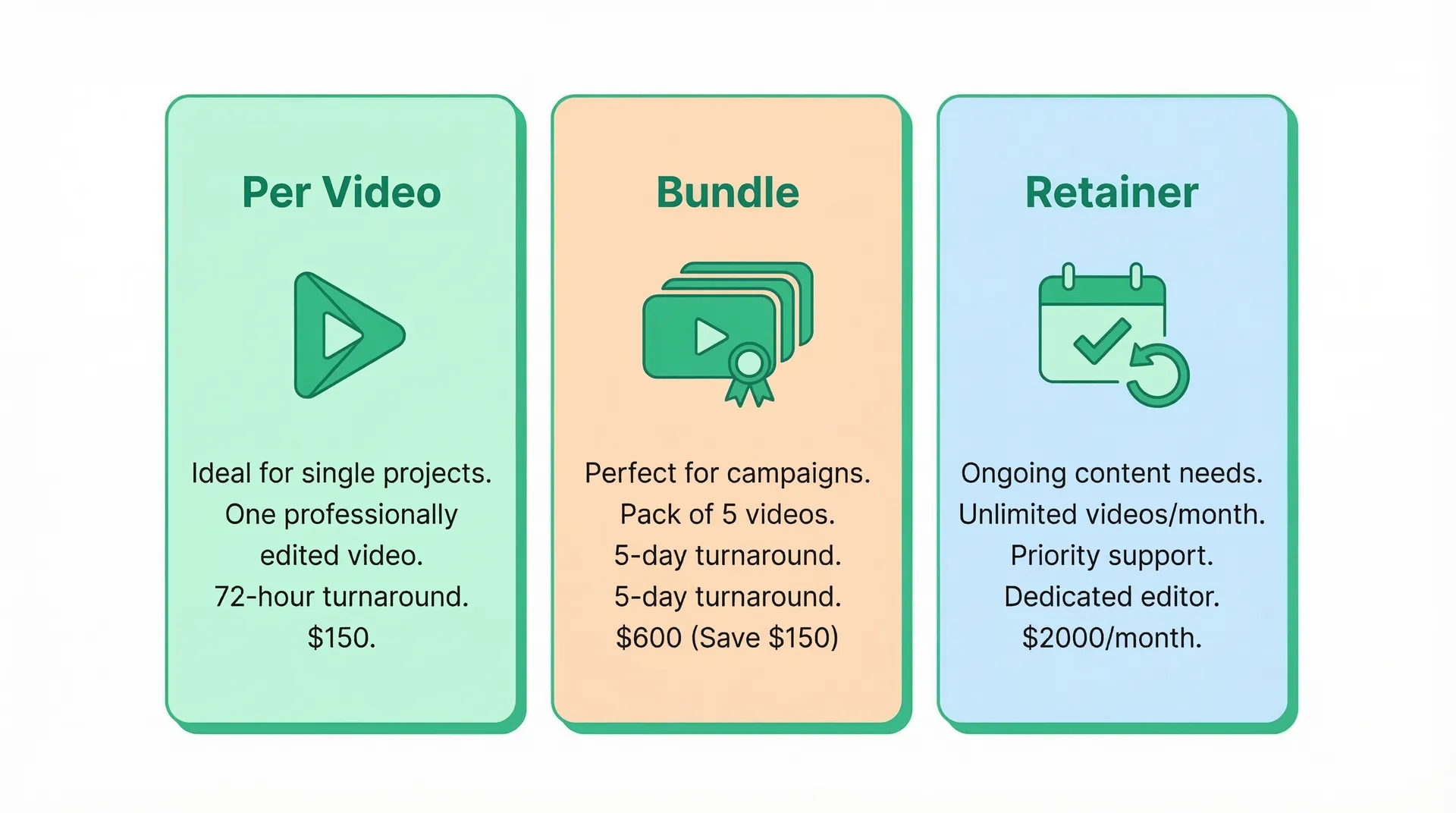
Tiered package pricing: the model that scales your business
Tiered packages are what you move toward once you've worked with enough brands to know what they actually need. Instead of a flat bundle, you present three structured options — call them whatever you want, but the logic is:
Basic: 2–3 videos, no revisions, standard usage rights, 2-week delivery Standard: 5 videos, 1 round of revisions, 90-day usage rights, 1-week delivery Premium: 8–10 videos, 2 revision rounds, 12-month usage rights, priority turnaround
Three things happen when you pitch tiers:
First, you anchor the conversation. The brand's brain immediately starts comparing options rather than asking "is this worth it at all?" You've moved them from a yes/no decision to a which-option decision. That's a significant shift.
Second, most brands pick the middle option. It's a well-documented pattern in pricing psychology. So design your Standard tier to be the one you actually want to deliver — the one with your best margin and your most comfortable scope.
Third, you make upselling natural. Brands that start on Basic often grow into Standard within two months. You haven't had to pitch anything. They've just seen the value and moved themselves up.
For tiered pricing to work, you need to genuinely differentiate each tier. Don't just add a video and charge more — add value. Usage rights extensions, faster turnaround, additional formats (vertical + horizontal cuts), or a dedicated strategy call all justify tier jumps. Check out UGC usage rights: how to price licensing fees if you're unsure how much to charge for rights at each level.
Design your middle tier first. Work backwards from what you want to earn monthly, decide how many brands you can realistically serve, and price accordingly. Then build Basic below it and Premium above it.
When to use which model
This isn't complicated, but most creators overthink it.
Use per-video when you're pitching a brand cold and want to minimize friction. A single video is an easy yes. Once they're happy with the result, you pitch a bundle or package for the next engagement.
Use bundles when a brand reaches out to you, when you're renewing with an existing brand, or when a brief clearly implies ongoing content needs (product launches, seasonal campaigns, evergreen ad creative). If a brand says "we need TikTok ads for our spring launch," that's a bundle conversation — see TikTok UGC rates: how to price your ad creatives for platform-specific guidance.
Use tiered packages when you've got a track record, a portfolio that does the selling for you, and you're ready to treat this like a business. Tiers work best when you're getting inbound interest — brands who already want to work with you are far more willing to choose a tier than negotiate a custom quote.
The hybrid approach most experienced creators use
Here's what I've seen work really well in practice: a tiered menu as your default, with bundles available as custom quotes for brands with specific needs.
You publish your rates clearly — three tiers, defined deliverables, listed usage rights. Most brands pick from there. For the ones with unusual briefs (10 videos in two weeks, specific platform requirements, or a niche that requires more research time), you quote custom.
This gives you structure without rigidity. Brands know what to expect. You're not reinventing the wheel every negotiation. And when a brand tries to negotiate down, you can show them exactly what they'd be getting at each price point — which makes the conversation much easier. See how to negotiate brand deals for tactics once you're actually in that conversation.
Don't publish a rate card with just per-video prices. Brands will always cherry-pick the lowest number and expect that rate regardless of scope. Tiered packages force them to engage with the full value of what you offer.
How to display your pricing
Whatever model you choose, your pricing needs to be clearly presented. In your media kit or portfolio, show deliverables and prices together — never one without the other. If you're building a rate card, how to build a UGC rate card that wins brand deals has a template you can adapt.
The beginner's breakdown on how much to charge for UGC is worth reading before you finalize any of these numbers — especially if you're early in your creator career and not sure whether your base rates are even in the right ballpark.
FAQ
Frequently Asked Questions
What is the best UGC pricing model for beginners?
How much should I discount UGC video bundles?
What should I include in a UGC pricing tier?
Should UGC creators publish their prices publicly?
What's the difference between a UGC bundle and a retainer?
How do I transition a per-video client to a package deal?
Related reading
- UGC creator salary & rates: what to charge in 2026
- How much to charge for UGC: beginner rates breakdown
- UGC creator retainer packages: how to price monthly deals
- How to build a UGC rate card that wins brand deals
- UGC usage rights: how to price licensing fees
- How to negotiate brand deals: scripts and tactics that work
- TikTok UGC rates: how to price your ad creatives