UGC usage rights: how to price licensing fees
Learn how to price UGC licensing fees for paid ads, whitelisting, and exclusivity. Add usage rights on top of your base rate and stop leaving money behind.

A brand offered me $300 for a UGC video. I said yes. Two weeks later I saw that video running as a paid Facebook ad — for a product with a $40 CPP and a $50,000 monthly ad budget. They spent more on coffee that month than they paid me to create the asset powering their entire acquisition funnel.
That was the last time I quoted a flat rate without asking how the content would actually be used.
UGC licensing is the piece of pricing that most creators either ignore completely or badly underprice. Your base rate covers the time you spend filming, editing, and delivering. The licensing fee covers what the brand does with the content after you hand it over. Those are two completely different things — and they should be priced that way.
Why ugc licensing fees exist (and why brands expect them)
Brands aren't surprised when you charge licensing fees. Any decent marketing team has worked with photographers, videographers, or ad agencies that charge separately for usage rights. The concept isn't foreign to them.
What surprises them is when creators don't charge it — and then get upset when their content runs for 18 months across every paid channel imaginable.
The core logic: the more commercial value a brand extracts from your content, the more you should be compensated. A video used once in an Instagram Story for organic reach has low commercial value. That same video running as a paid ad, boosted from the brand's account, tested across four ad sets for six months? That's a revenue-generating asset. Price it accordingly.
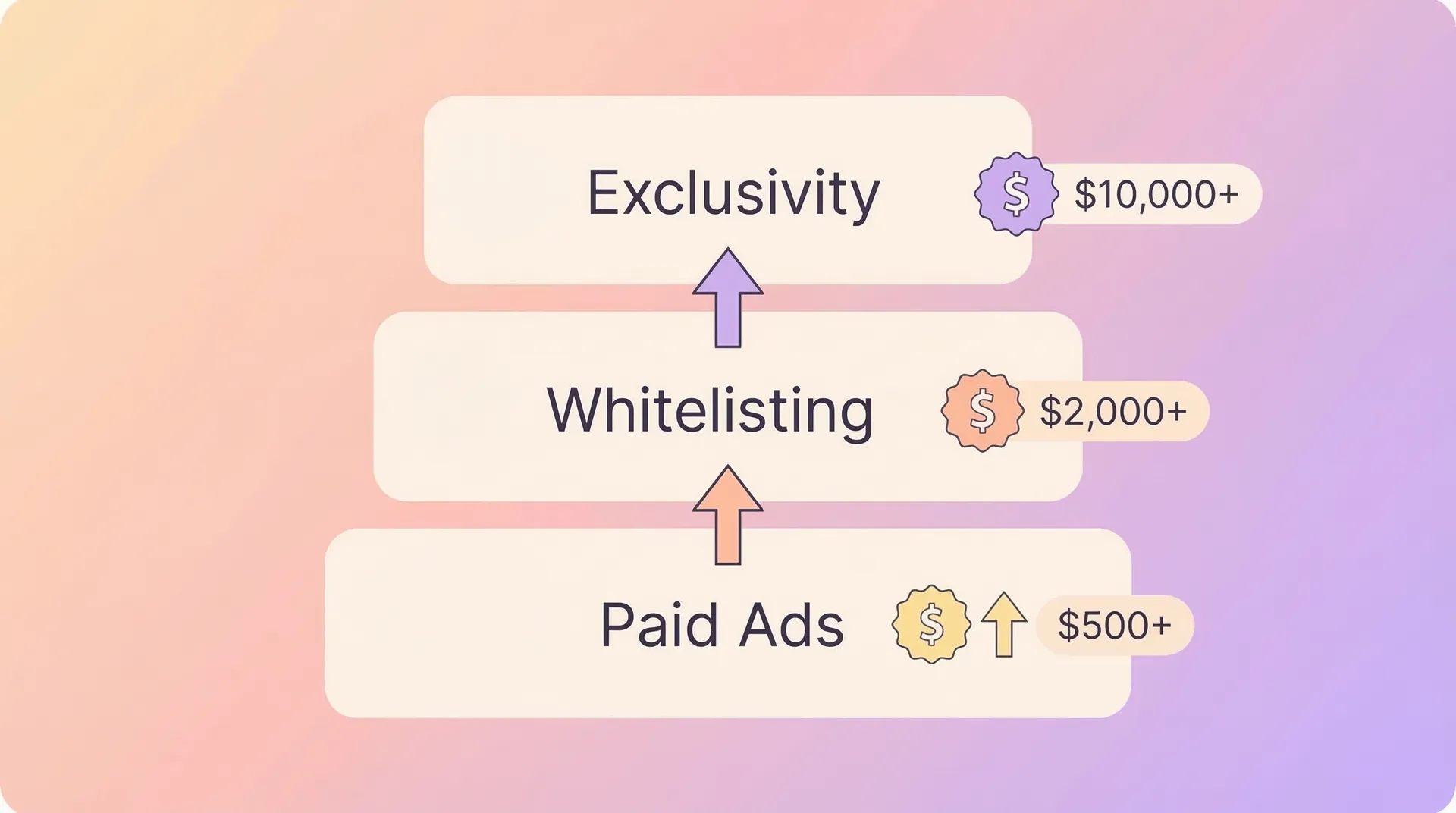
There are three main usage tiers you need to understand: paid media/ads, whitelisting, and exclusivity. Each one adds a different layer of value — and a different fee on top of your base rate.
Paid ads usage: the most common add-on
When a brand wants to run your content as a paid advertisement — on Meta, TikTok, YouTube pre-roll, wherever — that's paid media usage. Your content is now a commercial asset being put in front of potentially millions of people specifically to drive revenue.
Standard paid ads licensing runs 20–50% on top of your base rate per 30-day period. So if your base rate for a 60-second video is $400, a one-month paid ads license adds $80–$200. For a three-month campaign, you're looking at $240–$600 on top.
Some creators charge a flat monthly rate instead of a percentage. Ballpark: $75–$150/month for emerging creators, $200–$500/month for established ones. The right approach depends on how you present your rates — I'll cover structure in a moment.
Duration matters enormously here. Brands love to ask for "perpetual" rights. Don't give those away. If they want unlimited usage forever, that's a buyout, not a license — and it should be priced like one (typically 2–3x your base rate, minimum).
If you want a clear picture of what your full rate card should look like, including how to present base rates before layering on licensing, the guide on how to build a UGC rate card that wins brand deals covers exactly that.
Whitelisting: the fee most creators forget to charge
Whitelisting — sometimes called "dark posting" or "paid social amplification" — is when a brand runs paid ads through your creator account rather than their own brand page. Your handle, your face, their ad spend.
This is increasingly common on TikTok and Instagram. Brands get better performance from creator-attributed ads. You get... nothing extra, unless you charge for it.
Whitelisting should cost more than standard paid ads usage for two reasons. First, your personal brand and credibility are being used to sell. Second, it often means giving the brand access permissions to your account for the campaign duration, which has real downside risk if something goes wrong.
Add 30–75% on top of your base rate per 30-day period for whitelisting access. For a creator charging $500 for a video, a 30-day whitelisting license adds $150–$375. For a 90-day campaign, you're adding $450–$1,125.
Newer creators sometimes balk at these numbers, worried brands will walk. Some will. But any brand running serious paid social already has budget allocated for creator licensing — they're not going rogue when they ask for whitelisting access. They budgeted for it.
Exclusivity: the most negotiated line item
Exclusivity means you won't create content for competing brands during a defined period. Brands pay for this because they don't want their ad creative running alongside content you made for a direct competitor.
There are different scopes of exclusivity you should price separately:
Category exclusivity — you won't work with any brand in a specific category (e.g., "no other skincare brands for 60 days"). This is the most common ask.
Platform exclusivity — you won't post competing content on a specific platform.
Full exclusivity — you won't work with anyone in the category, anywhere, for the agreed period. Rare, and should be priced aggressively.
For category exclusivity, charge 25–50% of your base rate per 30-day period. A 60-day skincare exclusivity on a $400 video base rate adds $200–$400.
Full exclusivity is expensive to give. You're turning down other work. Price it at a minimum of 50% of your monthly revenue potential for the exclusivity window, or a flat rate that compensates for what you're genuinely forgoing.
One thing I always tell creators just starting to negotiate brand deals: read how to read a UGC campaign brief before quoting any usage tier. Briefs often bury usage expectations in the fine print, and if you miss it before signing, you have no leverage.
How to calculate your total licensing fee
Here's the framework I use. Start with your base rate (creation only). Then stack the applicable licensing tiers.
Example: Brand asks for a 30-second video with 3-month paid ads rights + whitelisting.
- Base rate: $350
- Paid ads license (3 months at 30%/month): $315
- Whitelisting (3 months at 50%/month): $525
- Total quote: $1,190
That's not gouging. That's pricing the actual commercial value of what you're delivering.
If you want to compare these figures against what creators at different experience levels are charging end-to-end, the UGC creator salary & rates guide has market benchmarks broken down by niche and tier — worth bookmarking.
Duration multipliers that actually hold up
Licensing fees should not scale linearly with time. A 12-month license is not worth 12x a 1-month license. But it should cost significantly more than 3 months.
Here's a sensible multiplier table:
| Duration | Multiplier vs. 1-month rate |
|---|---|
| 1 month | 1x |
| 3 months | 2.5x |
| 6 months | 4x |
| 12 months | 6x |
| Perpetual/buyout | 10–15x (minimum) |
If a brand wants 6-month paid ads rights and you'd charge $150/month for one month, charge $600 total — not $900. You're rewarding them for the longer commitment while still being appropriately compensated.
Perpetual rights are where creators give away the most value. Never agree to perpetual usage without charging at least 10x your monthly license rate. An asset running forever is an asset they never have to replace.
How to present licensing fees to brands
Don't just email a big number. Break it out clearly so the brand can see exactly what they're paying for. Line-item it:
Video production (1x 30-second UGC video): $350
Paid ads license (3 months): $315
Whitelisting access (3 months): $525
Total: $1,190
When pricing is visible, it rarely gets rejected on the spot. Brands push back on mystery numbers far more than itemized ones. They can see the logic, and they can go back to their team and justify it internally.
Also: always state the rights explicitly in your invoice or agreement. "3-month paid ads and whitelisting license for Meta and TikTok only." Not "usage rights." Vague terms are how brands end up running your content for three years and claiming they thought it was included.
If you're still figuring out what your base rates should be before you even get to licensing, start with how much to charge for UGC — it covers the creation side of the equation clearly.
The conversation you'll have
Brands will push back. "We usually just pay a flat rate." "Other creators don't charge for this." "Can we just do a buyout?"
On the buyout ask: fine, but price it at 10–15x your monthly license. If they balk at that, they didn't actually want a buyout — they wanted perpetual rights at a discounted rate, which isn't something you offer.
On "other creators don't charge this": some don't. Those creators are also leaving significant money on the table and eventually burn out or quit when they realize the math doesn't work. You're not competing with underpriced creators — you're setting your own standard.
On the flat rate push: offer them a flat rate that includes a defined usage period (e.g., "1 video + 90-day paid ads and whitelisting rights: $1,190 flat"). Now they have a clean number. You've priced it properly. Everyone moves on.
For more on how top-performing creators have structured their licensing conversations, this Creator IQ piece on licensing frameworks is worth reading. The American Society of Media Photographers usage calculator also gives a sense of how mature industries handle this — UGC is heading in the same direction fast.
And Contract Creator by Corey Haber is one of the better tools I've seen for actually documenting usage rights in creator contracts without needing a lawyer for every deal.